Read this article in 中文 Français Deutsch Italiano Português Español
Lift planning: experience, know-how and technology
17 November 2025
When planning a lift, project owners look for a team that has experience using a variety of crane types, capacities and makes, as well as access to the best lift-planning technology. Reporting by the team at the ALL Family of Companies.
Depending on a project’s complexity, before the first truckload ever arrives at a jobsite, the heavy lift to be executed has often already been thoroughly mapped out, planned and practiced to precision. Lift planning is a necessary step when preparing for maneuvers that involve machines and materials measured in tons.
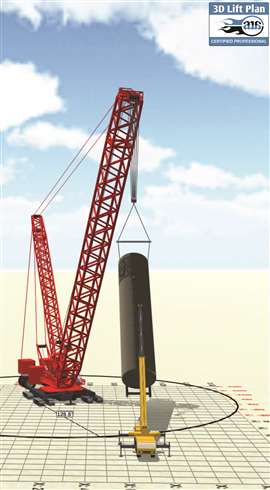
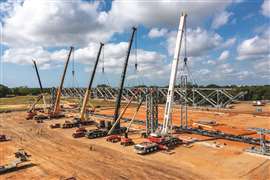 A lift plan is a visual document of what the job entails. A lift plan becomes a blueprint for how the lift team is going to perform the lift.
When planning a lift, project owners look for a team that has experience using a variety of crane types, capacities and makes, as well as access to the best lift-planning technology. Well-trained lift planners, who are constantly honing their craft, should be at the helm.
The ALL Family of Companies, the largest privately owned crane rental company in North America, is well-versed in the art and science of lift planning. It has more than 3,600 pieces of lift equipment in its fleet, access to lift-planning technology such as 3D Lift Plan, LICCON and AutoCAD, and ongoing lift plan training spearheaded by former ALL project manager, Chad Rados, who was recently promoted to director of crawler crane operations. Rados believes this access to more equipment, improved technology and ongoing training results in lift plans that do more than simply sketch out what needs to be done.
Telling the story
“The purpose is to tell a story,” Rados said. “When we’re sitting with a customer, we want to clearly demonstrate how their objectives can be brought to life, so they can determine the best equipment and lift plan for their job. I want to be clear: not every job requires a lift plan with the detail I am discussing, but when a customer requests one, that’s where we jump into action.”
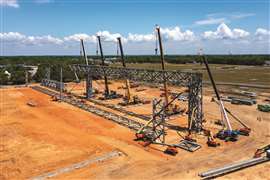 A good lift plan makes a project more productive. Everyone knows what needs to happen and the role they play.
Collecting data and putting it into lift plans for a presentation creates a visual document of what the job entails. It becomes a blueprint for how the lift team is going to do things moving forward. A good lift plan makes a project more productive. Everyone knows what needs to happen and the role they play.
For some lifts that may be novel or more complicated, lift planning provides a virtual reality space to try out different equipment and methods to determine the best course of action in the real world.
“There are standard things that will always be in the plan,” said Rados. “Your crane selection, its positioning and orientation, the load being lifted, where it’s being lifted and where it’s being set.”
The user is also able to plug in information about the weight of the load, lift radius, boom head elevation and more.
ALL Project Manager Brian Meek has worked for the company for 20 years, starting as an operator and most recently serving as a sales rep known for his own detailed lift plans.
“Generally, we’re doing lift plans that focus on the crane, the rigging, etc.,” said Meek. “But in others, we show the stages and planning. How we’ll enter the site, where trucks are to be staged and what crane is going to be used to assemble the other crane. Lift plans today can get incredibly detailed.”
There’s also data that will assist the customer in completing the lift safely.
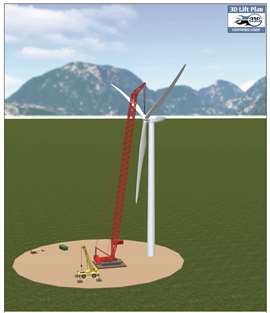 No matter if the lift is novel or complicated, lift planning provides a virtual reality space to try out different equipment and methods to determine the best course of action.
“By drawing it, we know the lift can be executed,” said Rados. “We’re fortunate to have any tool for the job that a customer might require. It all comes down to having the right people with the right knowledge base to make the lift happen.”
Real and virtual worlds
Lift plans all begin in the real world, move into the virtual realm of lift planning software and finally return to terra firma as planned lifts are executed on customer jobsites.
Hard work goes into taking accurate field measurements, noting any obstructions or clearance issues. The information gathered is entered into the lift planning software to help create the virtual environment. When using 3D Lift Plan, the user can overlay a satellite image of the actual jobsite and plan the lift using a Google Earth picture of the real location. The user is also able to choose from a variety of cranes preloaded into 3D Lift Plan.
Liebherr has its own lift planning software, LICCON (Liebherr Computed Control). It not only allows for creation of lift plans, but because many newer Liebherr crane models have LICCON directly in the cab, the crane operators can “practice” the lift ahead of time using the controls of the actual crane they will be operating during the lift.
“The operator is able to watch on screen as the virtual crane responds to his or her movements,” said Rados. “It’s an added layer of preparation before a lift.”
Communicating the plan in the field is a crucial step in a successful project, according to Meek.
“Doing this work ahead of time is great, but lift day is where it all comes together,” Meek said. “We brief the entire crew in a pre-lift meeting. Our operators are all talented enough to safely execute a lift. Following the plan is about helping to ensure those efficiencies that we’ve communicated to the customer are actually happening in the field.”
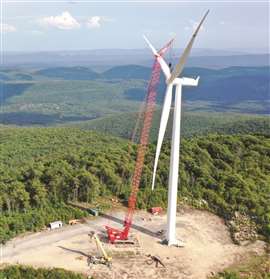 ALL uses a variety of software to design its lift plans; most plans are executed by a sales rep or branch manager.
Proving a concept
As a major medical facility in Columbus, OH, was being built, construction of the core forms far outpaced construction of the floors. So much so that it would be months before the tower crane tie-backs could be installed.
Project stakeholders needed an alternative plan. Waiting would be too expensive. The original plan had been for tower cranes onsite to dismantle the core forms but, without the tie-backs, the tower cranes couldn’t achieve high enough hook heights to do the work. Waiting would require the cranes remain on site and on rent, wasting time and money.
ALL proposed bringing in a couple of all-terrain cranes.
Besides height and weight, the site itself presented challenges for the ATs. Because the lower floors were already built, the only place the all-terrains could set up was outside the building footprint at a significant distance from the cores.
The proposal needed proof of concept that it was possible, practical, safe and cost effective to deviate from the original plan and remove the core forms with a mobile crane. That’s where lift planning came in.
“There were a lot of drawings, because there were a lot of phases,” explained Sam Moyer, general manager of ALL Tower Crane. “We wanted to convey that all aspects of the lifts had been considered and planned – from ground-bearing pressure to clearance of the in-progress construction to avoiding the tower cranes while assembling, scoping out and uprighting the mobile crane and making the picks themselves.”
 Communicating the plan in the field is a crucial step in a successful project.
In the end, thanks to diligent planning and careful execution, the concept became a reality and the core forms were dismantled early, saving the project significant cost. All because lift planning put everyone’s minds at ease.
Enter an engineer
Detailed as they are, all lift plans are clearly labeled as being for planning purposes only. However, some projects require a plan that’s more official. In these instances, a licensed engineer needs to be involved – and ALL has two of them on staff.
Moyer of ALL Tower Crane is one. The other is John Stolarczyk, heavy lift engineer, who works out of Dawes Rigging & Crane Rental in Wisconsin. (Stolarczyk is available to engineer heavy lifts for every ALL branch.)
Stolarczyk mostly works on mobile lift plans, in contrast to the tower work done by Moyer (although there is some crossover in their responsibilities).
“A lot of the job is creating and verifying lift plans,” said Stolarczyk. “ALL uses a variety of software to design its lift plans; most plans are executed by a sales rep or branch manager. And those are perfectly suited for many of the jobs we do.”
But if a customer or general contractor needs an official, stamped-by-an-engineer lift plan, that’s where Stolarczyk comes in. Most lift planning software has crane information already preloaded, divided by make, model and type. First, Stolarczyk has to double-check that the crane specifications loaded into the software are accurate; things like load charts, tip heights and more.
He also needs to gather information about the jobsite, to verify that the virtual environment within the plan is true.
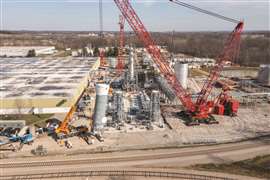 From the earliest stages of concept through to final execution, a well-crafted lift plan serves as both blueprint and assurance, aligning everyone involved in a project around a shared vision.
“For example, to authenticate radii, I need to know where the lifts are occurring, the reach to the delivery vehicle and the reach to the final position,” said Stolarczyk. “Any height the crane has to hit, I have to know if it’s clear or if there are obstructions. Then there are other details, such as, can a truck crane be steered here? Are we able to get different crawler crane components in?” Finally, he checks all the measurements and math used in the lift plan, making sure everything adds up.
From the earliest stages of concept through to final execution, a well-crafted lift plan serves as both blueprint and assurance, aligning everyone involved in a project around a shared vision. This is best achieved by combining deep equipment resources, cutting-edge technology and in-house engineering expertise to bring even the most complex lifts to life. In an industry where so much relies on precision, the key to a successful lift lies in the planning.
CONNECT WITH THE TEAM