Read this article in 中文 Français Deutsch Italiano Português Español
Mammoet Focus 30 performs for ExxonMobil
15 September 2025
Refinery maintenance benefits from Focus 30’s space and time-saving strengths.
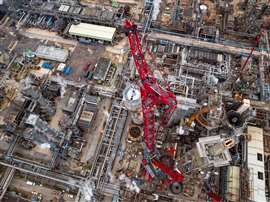 Looking down it becomes clear just how restricted the site was. Photo: Mammoet
Space is limited at the best of times in refineries and other industrial plants. It is often even more restricted when the site has been operating for some time and requires maintenance or repair.
Safety becomes even more important, closely followed by efficiency. If any form of shutdown is required, the pressure is really on to reduce downtime.
As part of maintenance activity at ExxonMobil’s Fawley Refinery in the UK, Mammoet exchanged a reactor head in the FCC (fluid catalytic cracker) unit.
Its self erecting Focus 30 pedestal crane came into its own by being erected vertically in the minimum of space. Focus 30 has a maximum load moment of 30,000 tonne-metres.
A huge advantage where space is restricted is that it requires only one sixth of the ground area a comparable crawler crane would need, Mammoet said.
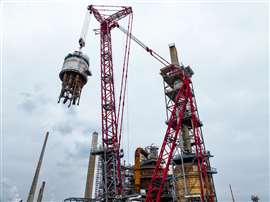 The 356 tonne reactor head was well within the capability of the 30,000 tonne-metre rated Focus 30. Photo: Mammoet
Doing the job
The old 356 tonne reactor head was replaced more quickly than other cranes could do it and the footprint was only slightly larger than a five-a-side football pitch, Mammoet said.
At the same site in 2006, Mammoet exchanged a regenerator unit using a PT50 ring crane. Despite size and capability advantages over competing crawler cranes, the boom had to be carefully assembled over live pipework as there was insufficient free space to do it at ground level.
Nearly 20 years later and with even less space on site, Mammoet suggested the Focus 30. This latest job was exactly what the crane was designed for – performing heavy lifts on sites with complex infrastructure and limited space. The boom is erected vertically, with lattice tower sections being inserted from the bottom and pushed up, instead of horizontally on the ground.
it allows faster assembly and the crane can be built in a 34 by 42 metre footprint. The crane’s boom does not need the space to be laid out flat before erection, which at best can block access roads or at worst just be impossible.
Early in the process Mammoet conducted a 3D scan of the refinery’s reactor and, using its Move3D planning software, created a visualisation of the project to show how the pedestal crane would be positioned and used on site. Combining this with 3D scan data identified any clashes on the congested site. Close proximity to an absorption column demanded a level of scrutiny and accuracy that couldn’t be provided by a traditional 2D approach, Mammoet said.
By carefully positioning the Focus 30 around existing infrastructure, hardly any alterations were needed in the field. Only one large pipe was identified early in the engineering process but it was quickly removed.
Load connection
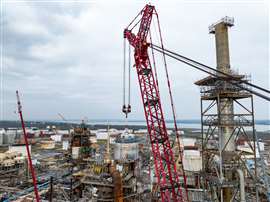 Mammoet’s Focus 30 self erecting pedestal crane performing a reactor head replacement, minimising downtime and disruption. Photo: Mammoet
Mammoet designed a specialist lifting beam to be inserted through the top nozzle of the reactor head and clamped to its interior. it had two large lifting pads to carry the reactor top from inside its plenum.
The crane was configured with a divisible superlift tray of 900 and 400 tonne sections, which made movement of the ballast fast and simple, while making sure the crane did not need to slew over live pipe racks with the load, Mammoet explained.
High winds are less of an issue than with crawler cranes, which would typically have to boom down at around 16 metres per second, disrupting operations on site. By storm anchoring itself to its own outriggers, Focus 30 can withstand conditions more than twice as harsh.
Koen Totté, sales manager at Mammoet, commented, “It takes around three to four weeks to assemble the Focus 30. By comparison, a heavy lift crawler crane would have taken around five weeks. We would also have needed to build its boom over the pipe rack, which would have been very time consuming and added risk due to working at a height of around ten metres over this live plant. With the Focus 30 we could work from inside the crane’s footprint, and not have to work at great height, making it a much quicker and safer alternative.”
STAY CONNECTED


Receive the information you need when you need it through our world-leading magazines, newsletters and daily briefings.
CONNECT WITH THE TEAM