Read this article in 中文 Français Deutsch Italiano Português Español
Mammoet highlights benefit of early collaboration in mega lift projects

19 May 2026
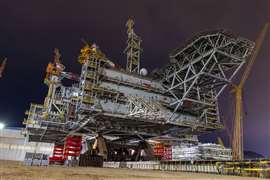 Mega Jack system under the topside structure (Photo: Mammoet)
Pre-planning is critical to the successful execution of a heavy lift project. This, according to lift specialist Mammoet.
Case in point is the production of a 33,000 tonne floating production platform for Woodside Energy’s Scarborough Project at the Qingdao McDermott Wuchan fabrication yard in China.
Mammoet was brought in during the early stages of the project – fully eight years before completion – to determine construction, lifting and transport of the colossal topside structure.
The floating production unit comprised two modules, the deck support frame and the topside, which would rest on the support.
This early collaboration meant that the topside would be easier and safer to move. The consultation also helped with achieving shorter project timelines.
Engineers at Mammoet explained they could save time by combining weighing and lifting operations. As it turned out, the project was the the first to use the company’s new Mega Jack 10000 system, which also permitted a lower starting height for the massive structure.
Eighty load cells, each with a capacity to read 750 tonnes, were inserted into the Mega Jack system so the load could be weighed as it was being lifted.
“The alternative method would have been to use load cells with hydraulic cylinders incorporated underneath, positioned at different locations around the topsides,” explained Richard Verhoeff, sales director at Mammoet.
He continued, “We explained that we could perform the weighing of the topside with the same system we use for the jacking. This makes things far more efficient between the two project phases.”
A standard Mega Jack system is supported by four jacking bases, one at each corner. Through the addition of special lifing beams in the superstructure, ten bases could be incorporated into one lifting system.
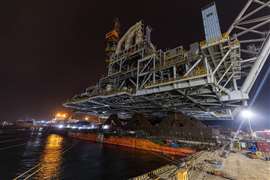 Loading the complete structure onto the transport barge (Photo: Mammoet)
The beams also doubled up as a build support during the construction process. Once the final weight of the topside had been verified, it was raised to 16 metres using the four towers. This allowed the deck support frame to be positioned underneath.
The towers then slowly lowered until the full weight was transferred to the deck support frame.
“The alternative approach would have been to fabricate the topside on top of its support frame. This method would have meant waiting for the module to be constructed first and the topside being fabricated at a height of 16 metres,” said Verhoeff. He noted that building at the additional height would have increased the project timeline and total cost.
Following this, the completed structure was pulled onto the installation barge in increments of 500 mm over a skidway using eight SJ850 strand jacks. Mammoet also supported the ballasting of the barge to ensure it stayed level under the huge weight of the completed structure.
The use of Mega Jacks meant additional load-spreading beams were not needed. Further, the system allowed the topsides to be constructed closer to the ground, improving operational safety and construction uptime.
STAY CONNECTED


Receive the information you need when you need it through our world-leading magazines, newsletters and daily briefings.
CONNECT WITH THE TEAM