Read this article in 中文 Français Deutsch Italiano Português Español
Research links crane operator certification to improved jobsite safety

25 August 2026
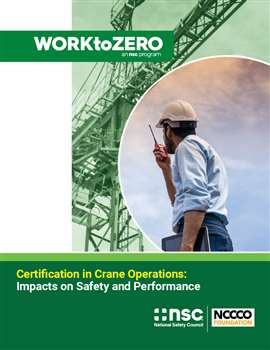
The National Commission for the Certification of Crane Operators (NCCCO) Foundation and the National Safety Council’s Work to Zero programme published new research on the relationship between formal crane operator certification, workforce competency and jobsite safety.
The report draws on existing research, national fatality data and survey responses and interviews with crane personnel to examine the impact of the 2010 OSHA Cranes and Derricks in Construction rule.
Key findings include that more than 90% of survey respondents said certified personnel improve jobsite safety, technical competence and career prospects. Nearly three-quarters of respondents said they support extending certification requirements to riggers and signalpersons, beyond crane operators.
The report also found that certification delivers the greatest safety benefits when combined with ongoing training, mentorship and practical experience.
Taken together, the findings point to a consistent theme: certification sets a higher floor for workforce competency.
Did the 2010 OSHA rule move the needle?
The data is more complicated than the topline framing suggests.
Crane-related fatalities in construction fell from an average of 36 deaths a year before the rule to 17.4 after it, a 51% drop. But when researchers ran an interrupted time series analysis to isolate the rule’s effect from the pre-existing trend, they found fatalities were already declining at a rate of 4% a year before 2010 ever took effect.
The model found no statistically significant change in fatality levels at either the rule’s 2010 introduction or its 2018 finalisation.
“The absence of a statistically significant change following the OSHA rule should not be interpreted as evidence that certification had no effect on safety,” the report said, attributing the decline instead to the cumulative effect of certification, training and safety culture improvements that had already been building since the 1990s.
If the causal story is murkier than the topline numbers suggest, the report’s clearest signal comes from the workforce itself, particularly on roles the federal rule doesn’t cover at all.
Should certification extend to riggers and signalpersons?
Neither role is currently subject to federal certification requirements, but the report found little appetite for the status quo.
Nearly three in four respondents said certification should be required for all lifts involving rigging, and certified riggers were rated more effective than non-certified peers across all eight competencies measured, including inspection, hazard recognition and load estimation.
An apprenticeship director and former operator explained why the margin for error matters: “There’s a million and one ways to rig something. People don’t realize how much you lose by placing one piece completely wrong, where a shackle is supposed to face one way and it’s now used sideways for whatever reason, and now you’ve lost 60% of your capacity.”
Support was less clear-cut for signalpersons. While a majority of respondents said certified signalpersons are more effective across five of six core competencies, that advantage nearly disappeared for nonstandard or site-specific signals; the one area OSHA permits departing from standardised signalling. Just 37% rated certified signalpersons as more effective there.
An industry trainer described how the gap opens up on site: “You teach them properly and they understand what the signal means, and then they get on the jobsite and they’re dealing with a crane operator who’s been in the seat for 20, 25 years... next thing you know, they’re just doing it the way the crane operator wants them to do it.”
Tellingly, support for mandatory certification was itself softer among signalpersons than among the workforce at large: only 60% of signalpersons surveyed backed a requirement, versus 73% of respondents overall.
Can credentials replace experience?
That pattern holds across the entire report.
Confidence gains after certification were strongest in classroom-taught, standardised skills like hazard identification and load chart interpretation, and weakest in judgment-heavy work like load handling and crew coordination. The gap shows up in how certification is maintained, too: just 35% of respondents said they receive refresher training annually or more, while the largest share train only once every four to five years, in step with renewal cycles rather than any operational need.
A tower crane operator summed up where the real education happens: “Certification is great. You know the basics and the rules, but there is so much more. Everything you learn in your first two years running a crane is more than what you’re going to learn in school.”
The report’s own recommendations land in the same place: position certification as a foundation rather than a standalone fix, expand it thoughtfully into rigging and signalling, and pair it with the mentorship and refresher cycles that let credentials keep pace with the job.
STAY CONNECTED


Receive the information you need when you need it through our world-leading magazines, newsletters and daily briefings.


CONNECT WITH THE TEAM