Read this article in 中文 Français Deutsch Italiano Português Español
Shifting dynamics: What to watch in US data center construction

21 October 2026
The environment surrounding data center construction continues to change.
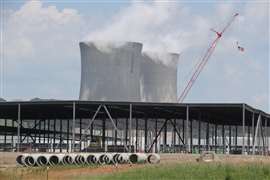 The cooling towers of Talen Energy’s Susquehanna Steam Electric Station are seen beyond an Amazon Web Services (AWS) data center construction project in Berwick, Pennsylvania. Photo: Paul Weaver/SOPA Images via Reuters Connect
With an August 18 executive order making its Governor’s Responsible Infrastructure Development (GRID) standards legally binding, Pennsylvania, USA recently became the latest state to introduce new requirements governing data center development, adding another example of a broader shift taking place around the country. After years of states competing aggressively to attract these projects, policymakers and communities are increasingly asking different questions; particularly who should pay for the infrastructure necessary to support them.
For Specialized Carriers & Rigging Association (SC&RA) members, this is a trend worth watching.
Pennsylvania’s new requirements bring energy affordability, environmental protection, water use, local hiring and community benefits more directly into the development process.
Data centers are also being removed from the state’s expedited permitting program, while developers will be expected to cover the cost of new electricity infrastructure needed to serve their facilities rather than passing those costs to other customers.
The implications extend beyond Pennsylvania, as well.
New York has paused permitting for large data centers, while Texas has scrutinized projects awaiting connection to its electrical grid. As of July, lawmakers in 15 states had considered some form of restrictions on data center construction.
The conversation now is no longer simply about where data centers can be built. Increasingly, it’s about whether the power, water, transportation and other infrastructure required to support them can keep pace, and how the costs and impacts of that development should be distributed.
Latest example
Pennsylvania offers a useful example.
More than 100 data centers were proposed in the state over the previous year, according to state officials. Yet only a fraction had progressed deeply into permitting, and just five had received all permits necessary for their first phase of development.
Projects already advanced may absorb additional requirements and keep moving forward, while earlier-stage or speculative developments have more flexibility.
That distinction matters for companies planning equipment, people and resources around anticipated construction activity.
Moreover, the data center market has moved so quickly that enormous project pipelines can create an understandable sense of certainty. But a proposed project is not a permitted project, and a permitted project is not necessarily a construction project.
SC&RA members should understand where the projects they’re tracking actually stand. Have major permits been secured? Is sufficient power available? Who is responsible for necessary grid improvements? Are water requirements becoming an issue? Is local opposition growing? Have state or municipal policies changed since the project was announced?
These aren’t questions crane and transportation companies are responsible for solving. But their answers can influence when — or whether — equipment ultimately arrives on site.
There may also be downstream effects for projects that proceed. Additional environmental requirements, local hiring commitments, community-benefit agreements and infrastructure obligations can increase development costs. More engineering, consulting and regulatory work can add time before construction begins. Changes in project economics can eventually influence schedules, procurement and contracting throughout the supply chain.
Enormous opportunity
None of this diminishes the enormous opportunity data centers continue to represent for our industry. It does, however, reinforce the importance of understanding the market beyond the work immediately in front of us.
Successful companies have always watched where future demand is developing. In today’s data center market, they should be watching something else just as closely: the conditions determining whether that demand becomes actual work.
Pennsylvania may be the latest example. It likely won’t be the last.
This article originally ran in the October edition of American Cranes & Transport magazine. Read the full edition here.
STAY CONNECTED


Receive the information you need when you need it through our world-leading magazines, newsletters and daily briefings.
CONNECT WITH THE TEAM