Read this article in 中文 Français Deutsch Italiano Português Español
Rough terrain cranes in perfect balance

28 January 2026
Manufacturers continue to increase the capacity and reach of their RT models, while maintaining the mobility and versatility that gives the cranes their unique selling points. Daniel Searle reports.
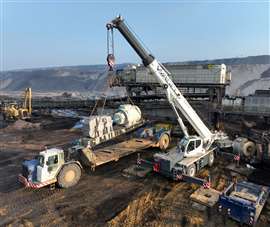 Liebherr LRT 1130-2.1 rough terrain crane from the Wasel rental fleet tackling the landscape of a mining site in Germany. Photo: Liebherr
As the name suggests, rough terrain cranes can operate across all manner of landscapes and job sites, working off-road and often in inaccessible locations, writes Daniel Searle, ICST contributor.
Yet despite these demands, manufacturers have still been able to increase the capacity of their RTs while maintaining functionality and strict safety requirements.
One recent example saw a 130 tonne capacity Liebherr LRT 1130-2.1 deployed at a huge open-cast lignite mine in Germany operated by energy company RWE. Challenges for mobile cranes don’t come much more comprehensive than mining operations, with major obstacles, including inclines and uneven and unstable surfaces.
The crane was hired out by Wasel to the Garzweiler mine in North Rhine-Westphalia, along with a smaller LRT 1100-2.1, to carry out daily repair and maintenance work on the mining equipment.
To interact with giant construction machines such as excavators, spreaders and conveyor belts, a relatively big RT was required. The LRT 1130-2.1, manufactured by Liebherr-Werk Ehingen in Germany and featuring a 60 metre telescopic boom and 29.5 R 25 tyres, is the largest rough terrain in the manufacturer’s portfolio.
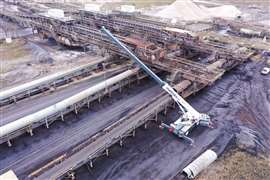 Rough terrain cranes are widely used in the mining sector. Photo: Liebherr
Crane rental company Wasel, based in Bergheim, near Cologne, is the contractual partner for Rheinbraun’s open-cast mining operation in the greater Cologne region. The company took delivery of the LRT 1130-2.1 to meet the changing demands of the mining sector, where equipment and conveyor systems have grown larger and heavier – such as conveyor belt rollers that weigh up to 60 tonnes.
“We have already had very positive experiences with the Liebherr LRT 1100-2.1 but our fleet lacked a more powerful rough terrain crane with single tyres for the operator RWE,” says Christopher Neuhaus, Wasel’s head of mobile cranes Bergheim. “When we drive into the open-cast mine, we need a very powerful wheel-mounted telescopic crane.”
The LRT 1130-2.1 is in continuous use at the site, across multiple shifts, thanks in part to its ability to traverse the challenging landscape.
“The new Liebherr RT weighs a good 45 tonnes without ballast, and around 60 tonnes when ready for use,” says Neuhaus. “This makes it relatively manoeuvrable, and it drives at up to 20 km/h with a sensational climbing ability of 60 per cent. This is extremely important in open-cast mining with washed-out roads and steep ramps – we take the ‘rough terrain crane’ category literally.
“After all, we have to use the large machines in all weather conditions and at all times of the year – so high ground clearance and climbing ability are extremely important. And of course, we’ve also chosen tyres with a corresponding profile.”
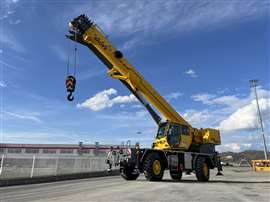 The Manitowoc Grove GRT550 rough terrain crane is the successor to the RT550E. Photo: Manitowoc Grove
Longer and stronger
Manitowoc launched the Grove GRT550 rough terrain crane earlier this year as the successor to its Grove RT550E. Following in the footsteps of its predecessor, the new model continues to offer the longest boom in its class, says the manufacturer.
It also continues the trend of RTs with increased capacities, with enhanced load charts amongst the new features.
Manufactured at Manitowoc’s Niella Tanaro facility in Italy, the crane’s five-section boom provides a 39 metre reach, with a 49 metre tip height possible when using the 8 metre offsettable swing away extension. Capacity is 50 tonnes, with line pull of up to 5,552 kg, representing an increase on the 5,100 kg offered by the RT550E.
Increases to capacity and reach must be made while maintaining the mobility of RTs, of course. With this in mind, the GRT550 is lightweight – similarly to its predecessor – with a GVW below 29 tonnes to allow the crane to travel on roads across Europe without a permit.
The model is also compact, with a 6.9 metre, 2.55 metre-wide carrier designed to improve transport and set-up on the job site and has the Site Steering mode feature to simplify handling.
Further features include Manitowoc’s MaxBase variable-position outrigger system, and a range of advances to assist the operator.
“Retaining features such as remote-mounted filters and centrally located service points shows just how technician-friendly the GRT550 is,” says Daniele Montanaro, product manager for rough terrain cranes at Manitowoc.
“And we’ve added advanced service and diagnostics features such as the Grove Connect fleet management system and our On Crane Service Interface. All are designed to make the technician’s job much easier, while uptime reaches new highs – exactly what owners are seeking in a powerful RT crane that’s capable of tackling all general handling and maintenance jobs.”
In North America, demand for RTs is being maintained partly by certain sectors, says Kelly Fiechter, product manager for rough terrain cranes at manufacturer Link-Belt.
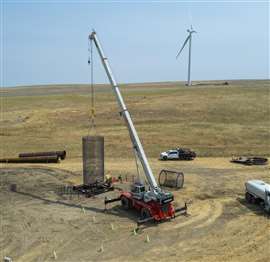 The 65 RT rough terrain crane, manufactured by Link-Belt. Photo: Link-Belt
“Into the fourth quarter of 2025, the RT market in North America is stable. We’ve seen a steady flow of cranes going to rental fleets as well as contractor-owned fleets this year, as infrastructure and project work have been keeping fleet owners busy. We anticipate this will remain the case heading into the new year.”
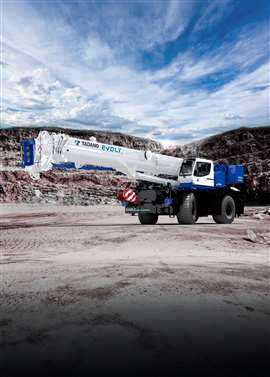 Tadano’s new fully-electric RT, the EVolt eGR-1000XLL-1, in operation at a quarry site. Photo: Tadano
Electric America
But while levels of demand may be summed up as ‘business as usual’, Japan-based manufacturer Tadano has altered the innovation landscape with the introduction of the region’s first fully-electric RT.
The EVolt eGR-1000XLL-1 provides the same lifting capacity as Tadano’s 100 ton GR-1000XLL-4, while offering the benefits of electric drive, which include reductions in carbon emissions and noise levels.
The crane’s on-board battery pack provides up to seven hours of lifting, or up to five hours of lifting plus five and a half hours of job-site travel. It is charged using standard 480 VAC grid power – which takes around five hours to charge fully – or a CCS1 rapid charging system, which reduces the time to between two and three hours.
To further extend the longevity of the battery, the model features regenerative braking – while plug-in operation provides continuous operation.
The evolution of Tadano’s electric RT involved overcoming specific challenges, says Kimihiko Terata, executive officer at the company.
“A major challenge in its development was the adoption of numerous electric components to power the large vehicle and their control. Moving a chassis exceeding 25 tonnes in total weight required large electric motors and high-capacity batteries. Efficiently controlling the substantial power needed to drive these components demanded optimal management of the total system. This product ensures driving performance and crane performance equivalent to conventional current diesel engine models.
“Regarding usability, it offers the same interface and operating feel. Electrification not only achieves zero CO2 emissions but also provides new value-added features: smooth and comfortable driving, improved maintainability, and significantly enhanced quietness.”
Terex takeover
There was a shift in the rough terrain landscape at the start of September, when Raimondi Cranes took over the rough terrain and tower crane arms of Terex.
Terex announced completion of the sales on 3 November.
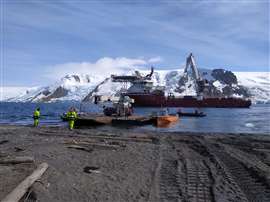 A Terex RT35 rough terrain crane, on duty in Antarctica. Photo: Terex Cranes
As part of the deal, Italy-based Raimondi acquired the existing Terex tower and RT crane manufacturing facilities in the north of Italy – an RT crane manufacturing plant in Crespellano and a tower crane facility in Fontanafredda – as well as the North American cranes service and support centre.
Talking to International Cranes and Specialized Transport at the time the move was announced, Luigi Maggioni, chief executive at Raimondi Cranes group, said that the rough terrain segment “opens entirely new market opportunities and applications. They allow us to serve customers in sectors and regions where mobility and adaptability are essential.
“The rough terrain crane business represents a cornerstone of this acquisition and marks a significant milestone in Raimondi’s long-term diversification strategy. For the first time in decades, Raimondi is entering a product segment that brings not only new opportunities, clients, and markets, but also introduces a distinct business model. This is an area we are not simply aiming to maintain but to actively grow and develop.”
STAY CONNECTED


Receive the information you need when you need it through our world-leading magazines, newsletters and daily briefings.
CONNECT WITH THE TEAM