Read this article in 中文 Français Deutsch Italiano Português Español
Tech talk: crane electrification comes of age

05 October 2026
Most tower cranes already run on electricity and now more mobile cranes are turning to electrified operation. All this while standalone electrical power delivery technology gets more advanced. Julian Buckley reports.
If you were to ask a person working outside the construction industry what tower cranes use as a power source, the likely the response would be “diesel”.
While the mental imagery of black soot emanating from an exhaust pipe dies hard in public memory, they’d be wrong. No specific numbers are available but it is estimated more than 90 per cent of tower cranes worldwide are powered by electricity.
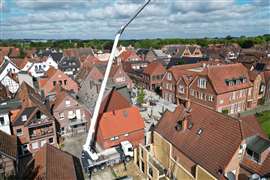
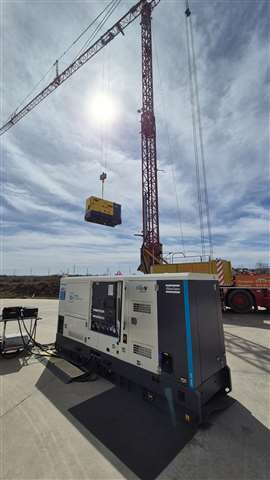 Atlas Copco in Zaragoza, Spain, demonstrating crane power delivery. Photo: Atlas Copco
The most obvious reason is that as a static machine there’s little benefit to having onboard fuel tanks. But there’s much more to it.
Electric motors deliver high torque from zero speed, which is ideal for moving and positioning heavy loads. Electrical current also allows better speed control. To further improve this, most cranes now use variable-frequency drives that deliver smooth acceleration and braking, reducing load movement and lowering mechanical stress on the crane structure.
Beyond this, electric motors use energy more efficiently than diesel engines. It delivers lower operating costs (both in power consumption and maintenance) which adds up to a lower total cost of ownership and reduced payback period on the investment.
Another benefit is zero exhaust emission at the point of use and a much lower noise, both of which allow the crane to operate on urban sites in compliance with regulations.
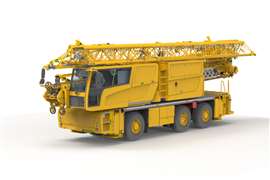 The electric Spierings SK487-AT3 eLift wheeled mobile folding construction crane. Photo: Spierings
Mobile cranes
As mentioned, static cranes lends itself to electric power, which is usually delivered from a building site’s microgrid (via a local generator set or the grid).
Mobile cranes, on the other hand, still largely rely on diesel power, although some battery-electric units are appearing on the market.
In 2020 Netherlands-based Spierings which first showed an electric crane concept in 2010, delivered its first SK487-AT3 eLift mobile cranes using diesel-electric power. These feature a carrier fitted with a series hybrid powertrain which has an electric-only road travel range of about 30 km. After that, an onboard John Deere 6.8-litre diesel engine recharges the 85 kWh battery pack.
The eLift system on this crane allows it to be operated with zero emissions when using a suitable power connection (16 or 32 Amp) – the crane is known as the City Boy owing to its suitability for urban work sites. If no connection is available, the crane operates as a diesel-electric hybrid.
An electric-only mode is a unique selling proposition but the hybrid model brings its own benefits. The engine uses just two litres of fuel per hour, while Spierings states a diesel-only equivalent would need around seven litres of fuel over the same period. The engine is Stage 5 compliant (without SCR emissions treatment), while a stop-start feature means it only runs when necessary. Switching between modes is fully automatic.
With a total weight of 36 tonnes, the three-axle crane lifts 7 tonnes, offers a maximum lift height of 52 metres and has a 40 metre jib.
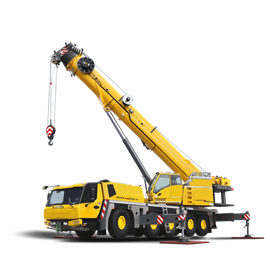 Grove’s GMK5150L-1e diesel-hybrid mobile crane can recharge its battery via the diesel engine when it is on the road. Photo: Grove
Similar drive
Moving up to 60 tonnes GVW, Manitowoc’s Grove offers the 150 tonne capacity GMK5150L-1e diesel-hybrid all terrain crane with 60 metre boom. Looking only at power delivery, this is remarkably similar to the Spierings SK487-AT3 eLift.
The five-axle carrier uses a Stage 5 Mercedes-Benz OM471LA 12.8-litre six-cylinder turbodiesel engine. There is no pure electric range but the crane superstructure only uses electrical power, delivered from a 160 kWh battery.
The battery pack can be charged using various external sources, either AC (at various power levels) or there is an optional DC high-voltage onboard charger which can deliver up to 200 kW. Interestingly, the battery can also be recharged using the engine (up to 170 kW) while the crane is on the road.
Latest entry
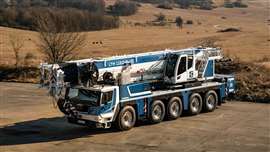 Liebherr’s LTM 1150-5.4 E hybrid wheeled mobile telescopic crane was first announced in April 2025. Photo: Liebherr
The most recently released model is the Liebherr LTM 1150-5.4 E. Unveiled at the Bauma construction equipment show in Munich, Germany in 2025, this 150 tonne capacity crane weighs 60 tonnes and has a 66 metre boom. It uses Liebherr’s own six-cylinder, 400 kW HVO-compatible diesel engine to drive the five-axle carrier, with full electric operation for the superstructure.
The crane can work for up to four hours using only onboard power delivery from the 99 kWh battery pack. Liebherr further adds that a ‘low electric grid connection’ is sufficient to deliver full crane performance, with the battery pack serving in this role as an energy delivery buffer. With full electric operation, the LTM 1150-5.4 E is suitable for zero-emissions construction sites.
Other features of the Liebherr hybrid crane include RemoteDrive. This allows the crane to be controlled from outside the vehicle. The operator can access the best viewing position for the operation, improving safety and functionality.
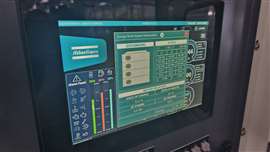 Graphical user interface screen from the new Integrated Hybrid range of power supplies from Atlas Copco. Photo: Atlas Copco
Hybrid source
Electrification of cranes is clearly advancing but, as crane technology moves forward, so do the power sources.
Atlas Copco is known for its air compressors used in a wide range of industrial applications. Not so well known are the company’s generator sets, even though the first was launched into the market in 1994.
In April 2026, Atlas Copco introduced its latest gen set in the Integrated Hybrid range. As the name suggests, this combines a diesel engine supplied by FPT Industrial with a 60 kWh li-ion phosphate battery.
To address the high peaks of energy draw common across in cranes, operators have opted to use battery energy storage systems (BESS). These can manage power spikes and also deliver zero-emission operation. But they are heavy and transport can be difficult and costly if off-site recharging is required.
The Integrated Hybrid gen set is designed to address the downsides of oversized BESS. Working alone, the onboard battery pack is designed to support short, intense bursts of power delivery. The onboard engine only comes online where power requirements demand or for pack recharging. As such, the new gen sets can deliver an 80 % saving in fuel usage over a diesel-only model, while cutting carbon dioxide emissions by the same level.
The ECO Controller system is used to manage power output, dependent on current draw. The system can include a battery health status check for insight into pack performance, which helps to improve efficiency and longevity. The packs are rated for about 6,000 charge-discharge cycles, which equates to a near 10 year life.
Three models are available: QHS 120 SS; QHS 200 SS; and the QHS 250 T4f. Power output ranges from 120 to 250 kVA.
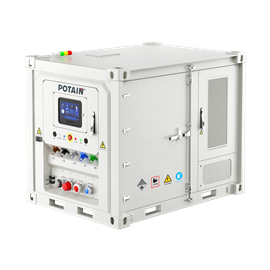 Potain Power Solutions offers this new unit for standalone tower crane power. Photo: Potain
Standalone tower crane power
Coming back around to where we started, in July 2026 Manitowoc introduced its new Potain Power Solutions range of energy storage systems for delivery of standalone electrical power to tower cranes.
Intended for remote work sites or areas with strict emissions and noise regulations, the new Power Solutions units are designed to manage the high-intensity duty cycles typical of tower cranes.
Output choices range from 135 kVA to 270 kVA and up to larger capacities exceeding 375 kVA. The energy storage systems have a high-rate discharge to support peak current demand during load hoisting, delivering full performance without voltage drops or power interruptions. In addition, the battery packs have a liquid cooling system to maintain performance in high temperatures and humid locations.
They are designed to integrate with Potain tower cranes, from entry-level models to specialized cranes, plus they can deliver power for other site equipment. Other features include grid stabilisation, levelling current to prevent damage to onboard electronics.
The units can withstand vibration and impacts and, unlike other larger BESS units, the Potain Power Solutions can be moved using a forklift.
“Potain Power Solutions help tower crane owners move toward smarter, more independent construction sites by maintaining peak productivity regardless of local infrastructure gaps,” said Robin Chen, new product development manager.
“By reducing the reliance on diesel generators they lower daily operating costs and help users meet their sustainability targets.”
The new power units will be available in Asia-Pacific, India, Africa, Latin America and Middles East.
STAY CONNECTED


Receive the information you need when you need it through our world-leading magazines, newsletters and daily briefings.

CONNECT WITH THE TEAM