Read this article in 中文 Français Deutsch Italiano Português Español
Artificial intelligence and the leadership lens

08 May 2026
Across industries, artificial intelligence (AI) has quickly moved from concept to boardroom priority.
Executives everywhere are asking a similar question: how fast should we adopt it, and where will it actually deliver value?
 Joel Dandrea, SC&RA CEO, says the important question about AI is how will industry leaders choose to apply it
Recent global CEO research underscores the tension leaders are navigating. While companies are investing heavily in AI and other emerging technologies, many are still struggling to translate those investments into measurable returns. At the same time, economic uncertainty, geopolitical instability and cyber risk are creating a complicated environment for long-term decision-making.
For leaders in the crane, rigging and specialized transport industry, that landscape may sound familiar. The industry has always been shaped by cycles, risk management and the need to balance immediate operational pressures with long-term investment decisions. AI simply adds another dimension to that equation.
Supporting role
Despite the enthusiasm surrounding AI, most companies are still in the early stages of figuring out where it truly fits. Global surveys of chief executives show only about one-third of organisations report meaningful revenue gains from AI over the past year. Even fewer say the technology has clearly reduced operating costs.
More than half of companies report no measurable financial impact at all so far. That doesn’t mean AI lacks potential. It simply reflects the reality that transformational technologies often take time to integrate effectively.
For SC&RA members around the world, that lesson is particularly important. Technology can help improve planning, documentation, scheduling and safety oversight. Yet the industry remains fundamentally physical. Equipment, crews and jobsite conditions still determine outcomes.
AI will not replace those realities. Instead, its greatest value may come from supporting them.
Familiar ground
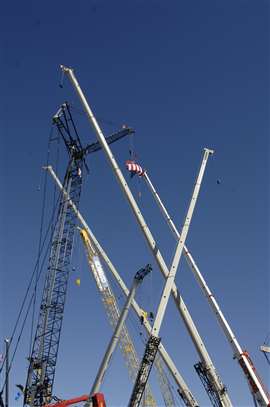 Booms of the latest new crane models, incorporating the highest level technolgy, criss-cross the sky at the ConExpo trade show in March 2026. Photo: Alex Dahm/KHL Group
Another takeaway from global leadership surveys is that executives are increasingly focused on reinvention – using technology not just to automate existing processes but to rethink how their businesses operate. At the same time, many leaders acknowledge they are balancing two different time horizons. Immediate challenges, such as market volatility and supply chain pressure, demand attention today, while technology investments may not produce returns for several years.
For crane and transport companies, that tension is nothing new. Fleet investments, workforce development and safety systems have always required long-term thinking. The difference today is the speed at which new digital tools are emerging.
It makes discipline even more important. Not every technology trend deserves immediate adoption, and not every digital platform will improve operations. Companies seeing the most value tend to approach technology strategically – focusing on tools that strengthen planning, co-ordination and decision-making rather than adopting new systems simply because competitors are doing so.
Operational realities
Ultimately, the question surrounding AI is not whether it will influence the future of business. That outcome is already clear. The more important question is how leaders choose to apply it.
For companies in the lifting and transport sectors, success will come from maintaining the same disciplined approach that has always defined the industry. Technology should support operational excellence, not detract from it. When implemented thoughtfully, digital tools can improve efficiency, strengthen safety and provide clearer visibility across complex projects.
But the foundation still comes back to leadership – understanding where innovation fits, where it adds value and where it does not.
In that sense, the most effective leaders will continue to rely on both the microscope and the telescope: focusing on today’s operational realities while keeping a clear view of the technologies shaping tomorrow’s opportunities.
STAY CONNECTED


Receive the information you need when you need it through our world-leading magazines, newsletters and daily briefings.

CONNECT WITH THE TEAM