Read this article in 中文 Français Deutsch Italiano Português Español
Ideas in action: Data centers, tariffs and AI top agenda at SC&RA Workshop

02 October 2026
The Centreville, Virginia-based Specialized Carriers & Rigging Association (SC&RA) held its 2026 Crane & Rigging Workshop in Omaha, Nebraska, September 22–24, with three days of education, networking and committee meetings at the Hilton Omaha and the CHI Health Center.
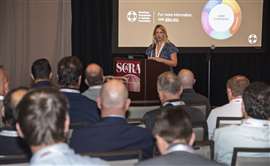 Committee meetings gave SC&RA members a forum to exchange experience, address emerging challenges and help shape industry priorities.
Tariffs dominated last year’s workshop, but the conversations in Omaha ranged more widely. Productivity, the continued data center boom, diesel prices and tariffs all came up in discussions throughout the week.
Attendance reached 753, including 158 first-time attendees and 39 international participants from 10 countries. Networking events and two well-attended evening receptions kept members connecting outside the meeting rooms, and 96 exhibitors filled a sold-out exhibit center.
What did the committees discuss?
The Crane & Rigging Group Tower Crane Committee covered structural and wind design, regulatory activity, workforce development, AI and the future of the sector. The committee also recapped the 2026 Tower Cranes North America event, held in Nashville in June, and recognized Morrow’s Peter Juhren, who retires at the end of the year after 46 years in the industry.
The Crane & Rigging Group Safety Education & Training Committee opened its meeting with a “Safety Minute” on mobile crane swing-path hazards. Mackenzie Pelaez of the American Foundation for Suicide Prevention (AFSP) then led a discussion on mental health. Through SC&RA’s partnership with AFSP and its Hard Hat Courage program, Pelaez addressed the construction industry’s elevated suicide rate, outlined the initiative’s industry-led approach and highlighted free educational tools and resources available to all companies. A committee roundtable then turned to field operations, including operating in the blind, telematics and near-miss reporting and sharing.
The Crane & Rigging Group Labor Committee began with reports from union partners representing the Operating Engineers and Iron Workers. The committee then revisited impairment testing with a demonstration of an ocular screening technology from GAIZE, designed to identify active worker impairment rather than simply the presence of a substance. Members also conducted an interactive SWOT analysis of the strengths, weaknesses, opportunities and threats facing the labor market.
The Crane & Rigging Group Governing Committee closed out the week’s committee activity with a “Lessons Learned” presentation on cargo securement, emphasizing safety, cargo protection, legal compliance and efficient execution.
Where do tariffs stand?
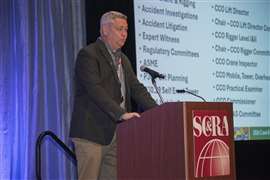 Education sessions throughout the Workshop gave attendees practical insight into the safety, technology and operational issues shaping today’s crane and rigging industry.
Following reports from association committees and industry partners, SC&RA CEO Joel Dandrea gave a tariff update on where the industry stands and what could come next. He said the association’s priorities include continued engagement with the Office of the United States Trade Representative (USTR) on Section 301 and 232 tariffs, efforts to reduce tariffs on tower and crawler cranes and high-tensile steel, and continued outreach to key members of Congress.
The meeting closed with new business on challenges surrounding the Motus U.S. DOT Registration System, as members discussed problems, potential solutions and their own experiences with the process, as well as operator hours.
What did the education program cover?
Derek Sather, chief risk officer at Sims Crane & Equipment, set the tone in the opening session, “Lift Director Essential – Roles & Responsibilities of Crane Jobsites,” which examined the lift director’s safety responsibilities across crane jobsites of all sizes.
Attendees could also book one-on-one meetings with National Interstate Insurance Company representatives to discuss company-specific risk management challenges, insurance structures and captive program options.
“It was a great Workshop overall – quite a few of the sessions were very well regarded,” said Harry Fry, SC&RA president and founder of West Newbury, Massachusetts-based Harry Fry & Associates. “Interestingly, many of the exhibitors told me the attendees in the Exhibit Center were among the most engaged and active they could remember.”
Earlier in the week, the Specialized Carriers & Rigging Foundation held its Educator’s Day, which brought local educators and industry representatives together to learn about crane, rigging and specialized transport careers, including training and certification requirements, employer expectations and opportunities available to students.
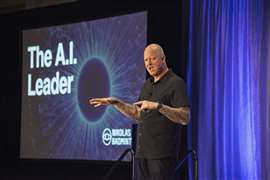 From lift planning and risk management to emerging technology and AI, Workshop sessions kept the focus on challenges and opportunities members encounter every day.
Keynote speaker Nikolas Badminton challenged attendees in “The AI Leader – Creating Incredible Productivity, Profit & Growth” to think beyond the immediate capabilities of AI and consider how leaders can intentionally prepare their organizations for accelerating change.
That theme carried into “Tech Made Simple – Everyday Tools That Make Your Crane & Rigging Business Run Smoother,” presented by Michael Cox of WrightPlan, Joe Frigo of Ribbiot and Shara Perez-Wilkinson of Fleet Cost & Care.
“I came away from the Workshop impressed by where our industry is today and where it’s headed,” said Mike Tomaro, chair of SC&RA’s Crane & Rigging Group, of Cincinnati, Ohio-based Fenton Rigging & Contracting. “From AI and emerging technology to critical risk and safety issues, the education was excellent. Combined with the opportunity to reconnect with friends and build new relationships, it made for an exceptional event.”
Other sessions tackled core operational issues. In “Fix the Fundamentals and Actually Save Money,” Cameron Boots of Gallagher, Dave Wittwer of Brown & Brown, Randy Proos of USI and Rick Emery of Emery & Karrigan examined safety, hiring, lift planning and documentation through an insurance lens. Kevin O’Neill of Bay Crane Companies and Mathieu Chaudanson of Lawrence K. Shapiro & Associates presented “Planning Load Handling Activities: ASME P30.1 and its Practical Application,” which focused on lift planning and preparation.
Joaquín Vega of Murlink explored the benefits, limitations and proper use of synthetic chain, while further sessions covered tower crane maintenance and rigging safety. In “What Happened? Accident Reconstruction & Application,” Jim Wiethorn of ICC Forensics walked attendees through accident reconstruction techniques and the lessons companies can apply to reduce risk and improve operational outcomes.
Who won the 2026 Rigging Jobs of the Year?
The “Top This – Showcasing the Year’s Leading Rigging Triumphs” breakfast spotlighted the association’s 2026 Rigging Jobs of the Year winners. Piqua, Ohio-based PSC Crane & Rigging took both the Under $300,000 and $1 million–$3 million categories, Sarens USA won the $300,000–$1 million category and Mammoet Americas won the Over $3 million category.
What comes next?
The week reflected an industry focused both on getting the fundamentals right and on preparing for what comes next.
“This event has always been about giving members information they can take back and put to work,” said Beth O’Quinn, SC&RA senior vice president, crane & rigging. “What stood out was not simply the attendance, but the diversity of participants and depth of conversation. The Workshop continues to connect industry professionals and newcomers to exchange ideas and look ahead – building strong anticipation for next year’s event in Lexington, Kentucky, September 28–30.”
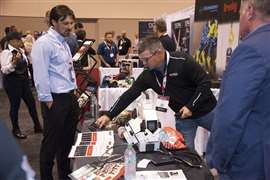 A sold-out Exhibit Center kept activity high throughout the Workshop, with 96 exhibitors connecting directly with attendees.
 Receptions and social events remained an important part of the Workshop, bringing members together from across the industry.
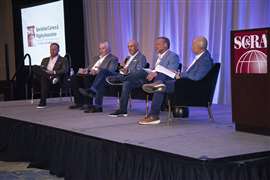 Industry experts shared real-world experience and actionable strategies across a wide-ranging education program in Omaha.
STAY CONNECTED


Receive the information you need when you need it through our world-leading magazines, newsletters and daily briefings.
CONNECT WITH THE TEAM