Read this article in 中文 Français Deutsch Italiano Português Español
Finance update: a resilient market
11 September 2025
Harry Fry discusses how tariffs, interest rates and the economy are affecting buyers of new and used cranes in today’s market.
It seems that to describe 2025 so far would be that businesses are “resilient” – they are continuing to focus on their work and equipment needs but also remain wary of what might be coming until the trade deals are completed.
For most buyers – whether companies are expanding their fleet or upgrading – financing is a crucial component in acquiring these expensive assets. Several external factors will influence the availability and cost of crane financing, notably tariffs, interest rates and the overall economic climate. Understanding how these elements impact financing options can help buyers make more informed decisions.
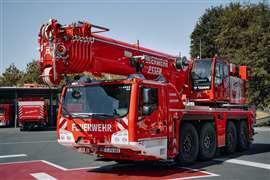
 Despite the impact of higher interest rates, tariffs and equipment shortages, some crane companies made the decision to move forward and purchase income-producing cranes and support. Image generated by AI using OpenAI’s DALL·E
Cranes play a vital role in the economy. They provide services from construction and energy sectors to building maintenance and even to simpler things in life such as art and leisure. The year 2025, to say the least, has been a very interesting year for the sale, leasing, financing and basic acquisition of cranes and their support equipment.
Interest rates have remained steady, but high compared to recent memory, but still moderately lower than historically encountered from years before. Tariffs have caused the biggest overall issue in the acquisition of cranes, both new and used.
Rates and credit
From the end of 2024 through the first quarter of 2025, the biggest concern was interest rates. Rates began to flatten and remained steady with minimal movements through the first few months of 2025. Credit requests, based on Tier 1 and 2 credit quality applicants and for newer equipment purchases began to see interest rates trailing lower, while standard business credit tiers on older equipment remained steady to the slightly higher end of the rate ranges.
Interest rates today are based on credit grade, quality of financials, age of the equipment and term requested. Currently, rates may range from 6.5 to 9 to 10 per cent, or higher. Many rate prognosticators anticipate lower rates into Q3 and Q4 2025, resulting in Federal Fund rates and, ultimately, the Prime rate dropping by 50 to 100 Basis Points (bps).
Overall, buyers have remained concerned about interest costs. Even though rates seemed high, especially to newer businesses, seasoned businesses of 10 to 15 years-plus remember Prime rate well over 7.5 per cent, in the 10 to 11 per cent range and even higher in the early 1980s. Therefore, some businesses have decided that there is no time like the present and have moved forward to purchase and finance their income-producing cranes and support equipment.
Credit in Q1 2025 is quite typical of Q1 every year. Banks and finance companies usually start out being more restrictive on credit. As the year goes on, if portfolios are amortising out and new loan acquisition goals are not being met, lenders tend to trend towards less restrictive credit criteria. I have been in equipment finance since 1981, and only on very few occasions has this scenario not played out. In my opinion, Q3 and Q4 2025 rates will come down and credit will become aggressive.
Tariffs impact
We all should be aware that the Specialized Carriers & Rigging Association (SC&RA), and several state and local crane associations, have been working together to make the White House aware of how tariffs have been and are affecting all aspects of the crane and lift industry.
No secret to anyone, tariffs have been the biggest business disruption in many decades. Whether you are for or against tariffs, our industry does not have the luxury of getting bogged down in this debate. It may take years to determine their merit. As an industry, including the equipment finance industry, we must move forward.
Tariffs have created a severe inventory shortage affecting both new and used crane sales, which has also affected the finance and lease industry. The ripple effect is large and wide. New crane, transportation and support equipment sales have severely disrupted the “crane food chain” of sales activity. New crane sales typically come into an existing rental fleet, as an upgrade or replacement. In many cases, an older or under-utilized crane from the fleet is available for sale or is traded in on the new purchase. That may set off a series of trades and sales adding cranes into the market. Since the tariffs were enacted, that series of events has been slowed to a trickle. If you cannot add or replace equipment with new, an owner may be less likely to sell used equipment out of their fleet.
So, how are tariffs perceived from a finance and lease perspective? The added cost of 15 per cent plus or minus on new cranes and equipment is concerning because it impacts how a lender can verify true value with their internal asset managers.
Can the credit request handle the added dollars, if 100 per cent or any portion of the tariff is passed to the buyer? Initially, there may be some trepidation by credit analysts as they may consider it a “soft cost,” but over time this will be accepted into the values and credit analysts will either be comfortable with the finance amount requested or not. Initially, the tariffs may create a similar concern with used equipment.
The issue with used cranes is determining comparison equipment values. If demand of used cranes rises quickly, unfortunately, the only crane values for comparison may only come from the auction results. This can be concerning because auction results are the only public record and typically encompasses a smaller equipment sample. The majority of used cranes are sold privately or consigned through a dealer or equipment broker network and unfortunately, access to private sales is not available. Therefore, a comprehensive guide providing market equipment values does not exist, unlike value guides seen in the car or truck and tractor industries, such as Truck Blue Book or Kelley Blue Book. This may be a problem, but we doubt it will be a long-term concern. It should be resolved, similarly as years ago when steel prices jumped quickly causing new and used crane prices to escalate, the values adjusted to the new “normal.”
The big questions
What does the second half of 2025 and 2026 hold for the crane, lift and transportation industry? Obviously, nobody can accurately predict the future since we never know what events may be lurking around the corner. However, we believe in the following:
Interest rates have been discussed in business forums ad nauseum, but it seems reasonable that by year-end 2025 rates may be approximately 50-100 bps lower. As we proceed to 2026 Q2-Q3, we expect rates to be reduced by another 50-100 bps. Rates will be in position for the second part of 2026 to facilitate strong sales.
But there are some “ifs.”
If tariffs are ultimately absorbed into new and used equipment cost and buyers’ projections indicate profitability with their equipment acquisitions that will start the move forward.
If credit analysts understand and accept cash-flow coverage with the tariff-induced rise in equipment cost, this will be a needed phase to help move the markets forward.
If manufacturers can ramp up production and overseas shipping can handle the transportation of new crane and support equipment, this will enhance new and used inventories thereby further activating the market.
As noted, a lot of “ifs,” but by combining all these factors and no unforeseen cataclysmic events the crane, lift and transportation industries may be set up for a very positive, multi-year run.

THE AUTHOR
Harry Fry started his career in finance in 1981, working for Mercedes Benz Credit Corporation, running executive operations for the USA and Canada. In 1995 he started Harry Fry & Associates, specializing in cranes and heavy equipment financing. His wife Cheryl Fry joined the company in 1996 and then their daughter Tonya Fry joined the company in 2004. Harry Fry & Associates has been providing financing for 30 years, placing more than US$1.5 billion.
STAY CONNECTED


Receive the information you need when you need it through our world-leading magazines, newsletters and daily briefings.
CONNECT WITH THE TEAM