Read this article in 中文 Français Deutsch Italiano Português Español
Sennebogen makes sustainable moves

24 January 2025
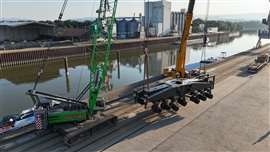 Loading the 107 tonne undercarriage of a new Sennebogen 9300 E port crane. All eight machines together weighed 700 tonnes. Photo: Sennebogen
Sustainability and cost were key factors when eight large new materials handling machines had to be shipped from Germany to the USA.
Manufacturer Sennebogen in Straubing needed to get an order of new large machines from its factory, via Antwerp in Belgium, to Charleston, South Carolina. It enlisted specialist heavy logistics company Karl Gross from Regensburg for the job. Choosing to use barges brought sustainability and cost advantages, Sennebogen said.
Loading the machines onto the barge presented logistical challenges. The machines, including Sennebogen 855 and 870 materials handling models, each weighed between 70 and 105 tonnes. They have long booms, removable counterweight and some had wheels while others were on crawler tracks. Special measures were required to get them loaded onto the barge, Sennebogen said.
“As the machines could not be lifted completely, we had to dismantle the counterweights on site and reassemble them after loading. It was also necessary to temporarily close the road between the Sennebogen plant and the port,” explained Roland Hermann, Sennebogen head of customs and foreign trade machine shipping.
 A 180 tonne Sennebogen 5500 E lattice boom crawler crane lifts in tandem with a rail mounted harbour crane to load one of the eight new machines into the barge. Photo: Sennebogen
Lifting in tandem
For the loading it was decided to use a pair of cranes lifting in tandem. “The challenge was to lift the machines into the barge without any interruptions or jolts. The first machine was loaded at 7 a.m. and seven machines were safely stowed by midday,” Hermann said.
After leaving Straubing some of the machines were loaded straight on to the ocean-going vessel in Antwerp. The remainder were transported on to the port of Zeebrugge.
Transport via inland waterways offers considerable environmental benefits, Sennebogen said. “While carbon dioxide emissions for road transport are around 113 grammes per tonne-kilometre, they are only 34 grammes for transport by inland waterway vessel. This reduces CO2 emissions for the approximately 800-kilometre route by 75 per cent, which corresponds to a saving of around 49 tonnes of CO2.”


CONNECT WITH THE TEAM