Read this article in 中文 Français Deutsch Italiano Português Español
SPMT in spectacular historic ship move

06 October 2026
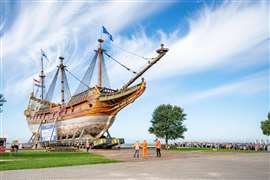 Q3 Heavy Lift supplied the SPMT, did the transport, the detailed cradle engineering, the roll-off, jacking and final placement of the ship. Photo: Peter van Aalst
Self propelled modular transporter (SPMT) was the vital element in the final part of a job to transport and install a historic wooden sailing ship weighing hundreds of tonnes at a museum in the Netherlands.
At nearly 60 metres long and 10.5 metres wide the Batavia is a full size modern recreation of the Dutch East India Company’s original from 1628. It was completed in 1995 after a ten year build.
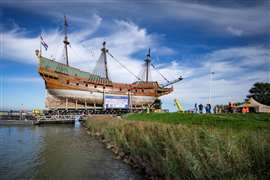 Preparation for the operation included removing the vessel’s cannons and some of her ballast and installing temporary steel supports inside the ship. Photo: Peter van Aalst
Having now spent more than 30 years in the water the ship needed to be taken out for repairs and conservation work.
It was towed 50 km to Damen Shiprepair Amsterdam where, with the help of a dry dock it was brought ashore and then loaded into a custom-built steel support frame or cradle and all put on to a pontoon.
Dutch specialist contractor Q3 Heavy Lift assembled two SPMT trains in Dordrecht and shipped them on a pontoon to the Amsterdam yard, where they were driven onto the main pontoon, taking up position beneath the cradle.
The ship in its cradle on the pontoon was then towed by Koninklijke Van der Wees back to Lelystad, on the coast north east of Amsterdam, prior to offloading. With the pontoon carrying the ship docked end-on at the Museum Batavialand, the offloading could begin.
On 2 October the two SPMT columns, each of 28 axle lines with power pack units, were driven under the ship which was in its cradle. Using the hydraulic suspension of the SPMT the 646 tonne ship (ballast had been removed) and its 101.2 tonne steel and timber cradle were lifted, ready to drive off the pontoon.
An offloading ramp had been prepared and the pontoon was trimmed to meet it. Load spreading and crane mats were laid over the Markermeer dyke’s footpath. Then came the dyke itself which was the governing constraint as the land behind it is well below sea level.
Working together
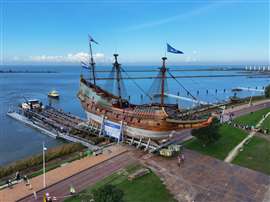 Batavia’s masts and rigging were kept in place for the move. Photo: Sander Wit
Close collaboration was called for with the Directorate-General for Public Works, the Water Authority Zuiderzeeland, the Province of Flevoland and the Municipality of Lelystad. The ramp was built long to minimise the approach angle and keep the ground pressure as even as possible.
The move followed a pre-determined path, taking into account ground pressure, subsoil conditions and buried services all along the way. Lamp posts and other street furniture along the route was temporarily removed.
“It is only 250 metres but if you drive over a pipeline you didn’t know was there, you have a problem,” said Ard Suvaal, group technical lead at project logistics specialist Trans Global Projects, which handled project management, risk analysis, permitting and public safety for the operation. “That groundwork is what makes the difference on a job like this.”
Using a computerised remote control, with the SPMT carrying the ship backwards, the transport negotiated the ramp, crossed the dyke and travelled the 250 metres into the grounds of the museum.
The next day, again using the SPMT hydraulics, the ship in its cradle was lowered onto a concrete foundation ready for refurbishment and conservation work to begin.
The number of axle lines needed was governed not by the load weight but by the rigidity requirement: 56 axle lines spread the load enough along the length and width of the cradle to stop it deflecting under the weight of the vulnerable wooden hull.
“What people see today is the result of a very long preparation process,” Suvaal said, “Several hundreds of hours have gone into the project planning, engineering co-ordination, risk analysis, permitting and preparation. With a vessel like the Batavia, every stage influences the next one, so the complete sequence had to be considered from the start.”
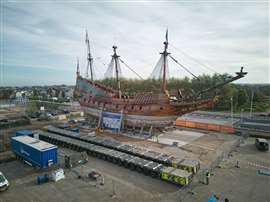 After 15 months of engineering and planning the project came to fruition. Photo: Museum Batavialand
Prominent project
Batavia now stands more than 8 metres higher than when berthed at the museum’s quayside, making it visible across the surrounding area. It will be the centrepiece of the redeveloped Museum Batavialand. opening at the end of 2028.
Ard Suvaal commented, “We move large steel structures for a living – transformers, oil and gas, offshore. Usually, almost nobody sees those projects and it usually just inconveniences local people along the route. This time we have a reconstruction of a 17th Century VOC ship standing on the trailers, in full public view and with a lot of guests and media watching the operation. I am proud of that, and even more of how this team worked: all the partners put their calculations, ideas, second thoughts and solutions on the table and solved things together rather than waiting on each other.”
The Museum Batavialand presents the history of Dutch land reclamation, water management and maritime heritage. It needs funding to help build a shelter over the ship to keep the weather off it. It is part of the museum’s redevelopment, bringing its shipyard, the Batavia and its exhibitions together on one site scheduled to reopen at the end of 2028.
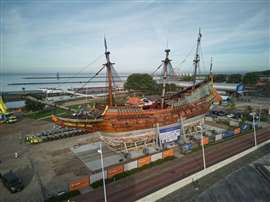 Batavia in its final position on the concrete pad. Photo: Museum Batavialand
STAY CONNECTED


Receive the information you need when you need it through our world-leading magazines, newsletters and daily briefings.
CONNECT WITH THE TEAM