Read this article in 中文 Français Deutsch Italiano Português Español
Two Wolffkran luffing cranes tackle complex California hospital build

08 October 2026
Two Wolff 1250 B US luffing cranes are constructing a new hospital building on the campus of the University of California San Francisco while the existing facility remains fully operational.
Wolff said it’s one of only five of this crane model currently working in the United States, and the first time two have operated together on a USA construction site.
The project, the UCSF Health Helen Diller Hospital in the Parnassus Heights neighborhood, involves constructing a new 15-storey building with approximately 83,600 sq m of gross floor area directly adjacent to active patient care areas including operating rooms and the Emergency Department.
The cranes, erected in spring 2025, work from the site perimeter rather than the center; a function of the triangular plot’s constraints. Squeezed between the existing hospital, residential neighborhoods and a forested area, the site is accessible via a single road. The cranes’ 65-metre jibs allow them to cover the majority of the construction area from those perimeter positions.
Each crane stands freestanding on specially engineered foundations of pipe piles and steel grillages; conventional foundations were ruled out by California seismic requirements and neighbouring utilities. One crane tops out at 79 metres tower height, the other at 85 metres (with jibs raised, both reach approximately 152 metres overall).
A tight worksite inside an active healthcare campus
 San Francisco presents highly complex conditions for tower crane operations. For the Helen Diller Hospital project, the WOLFF 1250 B cranes were capable of meeting the requirements due to their lifting capacity and exceptional free-standing heights combined with slender tower designs. Photo: Wolffkran
Both cranes will remain in place through interior fit-out after the structural shell is complete, since there is no room for mobile equipment once construction closes in. Their 3.3 x 3.3 metre tower footprint was a key selection factor given the site constraints.
The cranes handle essentially all material movement on the site, including steel box columns weighing approximately 32 tonnes each. At times both cranes work together to trip these columns from horizontal to vertical. When no ramp to the basement level was feasible, the tower cranes lowered a 38-tonne mobile crane into the basement.
Since cranes can swing over existing hospital buildings only with an empty hook, all construction activities adjacent to patient care areas required advance coordination with hospital departments on noise, dust, vibrations and exhaust. Some clinical operations temporarily relocated during particularly disruptive phases. Site preparation began in 2022.
Complicated dismantling
 One WOLFF crane assembles the other. Photo: Wolffkran
A further complication: one crane will dismantle the other at project’s end. This is standard practice in many markets but extremely rare in California, where the procedure required Cal/OSHA approval three years before the first crane was erected.
Dismantling of the second crane, which will require a 600-tonne mobile crane working from multiple positions along the adjacent emergency vehicle access road, is scheduled for early 2029 and is expected to take several weeks.
“The construction site conditions here are significantly more challenging than on those projects in downtown San Francisco,” said Drew Szabat, construction manager for the project. “The ongoing hospital operations, combined with the geological challenges and the extremely limited logistical possibilities that San Francisco presents, meant that the two Wolff 1250 B US cranes were the only machines that could meet the requirements of our project.”
The US$4.3 billion project is scheduled for completion in 2030.
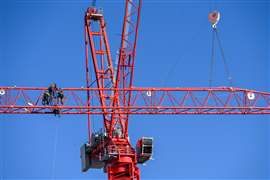 One WOLFF crane assembles the other and will later dismantle it as well. In California, such a dismantling operation is permitted only under the strictest regulations and is considered highly unusual, requiring years of advance planning and regulatory approval. Photo: Wolffkran
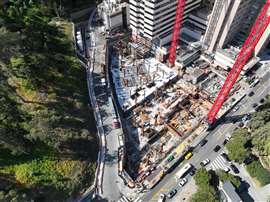 The confined construction site offers very little room for material handling, logistics or construction vehicles. Throughout the entire project, the two WOLFF 1250 B cranes serve as the site’s primary transportation system. Photo: Wolffkran
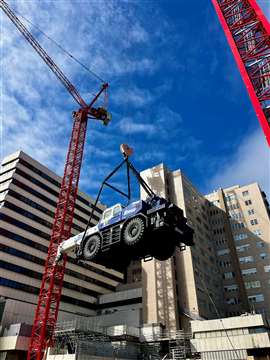 The cranes even lowered a mobile crane weighing approximately 38 tons into the basement level. Photo: Wolffkran
STAY CONNECTED


Receive the information you need when you need it through our world-leading magazines, newsletters and daily briefings.
CONNECT WITH THE TEAM