Read this article in 中文 Français Deutsch Italiano Português Español
Mobile crane dismantles 75-year-old canal bridge in Germany

04 November 2026
Replacing a dilapidated single-lane arch bridge in Germany required a crane balanced on steel cylinders anchored four metres below its own working level, right at the edge of a canal.
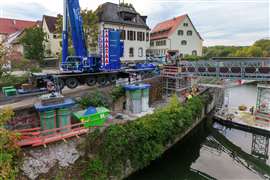
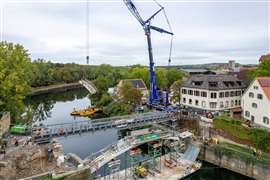 The LTM 1650-8.1 swings a bridge segment over the canal, past the temporary footbridge it installed before demolition began. Photo: Liebherr
The job belonged to contractor MSG Krandienst, which deployed a Liebherr LTM 1650-8.1 all-terrain mobile telescopic crane to dismantle the 1951 structure crossing a 40-metre-wide canal between the town of Lauffen am Neckar and a small island. The bridge had reached the end of its service life, with its load-bearing capacity no longer meeting structural requirements.
Available space on the riverbank forced MSG Krandienst to position the crane’s river-side outriggers outside the standard installation plane, supporting them on steel cylinders anchored to concrete foundations approximately four metres below the crane’s working level. An auxiliary cylinder under the rear of the vehicle assisted assembly on the sloping site.
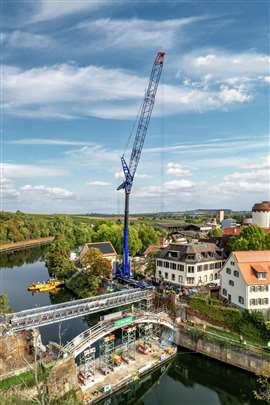 Rigged with a 35-metre luffing jib and 175 tonnes of counterweight, the crane rises over the 1951 arch bridge and the height-adjustable pontoon beneath it. Photo: Liebherr
“The topography on site severely restricted our options for setting up the mobile crane,” explained Christian Spreuer, a qualified engineer responsible for project planning for large cranes at MSG Krandienst. “Due to the narrow installation area, we had to position the river-side outriggers outside the actual installation plane, using large steel cylinders on concrete foundations situated around four metres lower down. The auxiliary cylinder under the rear of the vehicle was a great help to us during crane assembly, as it made it much easier to support the rear outriggers on the sloping road.”
The crane was configured with a 35-metre luffing jib and 175 tonnes of counterweight. Before demolition could begin, it installed a temporary footbridge across the canal and transported construction equipment to the island at a reach of 50 metres.
The bridge superstructure was dismantled section by section before the supporting arch was cut into five segments using concrete saws. A height-adjustable pontoon, positioned beneath the arch and equipped with scaffolding piers, supported the structure during cutting. The heaviest single pick was the apex section of the arch at just under 44 tonnes, lifted at a reach of more than 36 metres.
Liebherr’s VarioBallast system allowed continuous counterweight adjustment across varying load conditions and working radii of 26 to 50 metres throughout the multi-day operation.
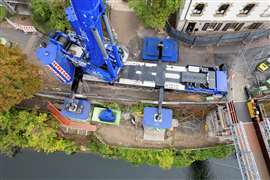 An overhead view shows how tightly MSG Krandienst’s LTM 1650-8.1 fits on the canal bank, with its river-side outriggers set outside the standard installation plane. Photo: Liebherr Photo: Liebherr
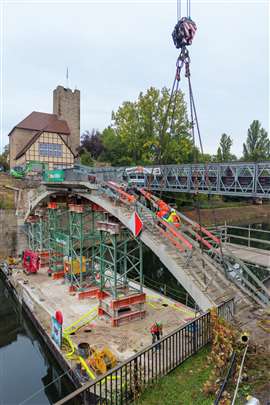 Crews rig an arch section for lifting while scaffolding piers on the pontoon support the structure during cutting. Photo: Liebherr
 Steel cylinders anchored to concrete foundations about four metres below the crane’s working level carry the river-side outriggers. Photo: Liebherr
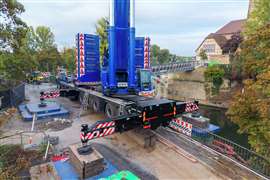 Timber cribbing levels the crane’s outriggers on the sloping site. Photo: Liebherr
CONNECT WITH THE TEAM