
07 January 2026
Rounding up some recent projects from around the world completed using the unique capabilities of self propelled modular transporter
 World record 7,500 tonne base move on SPMT. Photo: Blueocean
The unique capabilities and benefits of self propelled modular transporter continue to be demonstrated on ever more spectacular projects. Here is ICST’s roundup of recent projects from around the world demonstrating just how useful SPMT can be.
First off, we have a new world record move on SPMT completed in China. The job was to transport and load out the giant hollow steel foundation for the Three Gorges Corporation’s Pioneer 16 MW wind turbine. The wind turbine on top of the foundation has 123 metre long blades for a rotor diameter of 252 metres and a swept area of about 50,000 square metres.
Vastwin (Zhonghai Guangying Engineering Logistics Co, Ltd) made the historic move at the vast Blueocean Wind offshore engineering yard in Guangxi. The EPC contract value was approaching US$3.5 million.
Vastwin used 244 axle lines of mostly Scheuerle SPMT with 13 power pack units (PPU) to move the 7,500 tonne fabricated steel structure. Underneath the centre connection point, where there was the greatest load, were 92 axle lines of the higher capacity 60 tonnes per line SPMT.
The operation required a ground bearing capacity at the quayside of 13 tonnes per square metre and no reinforcement was required. In addition to its vast weight, the dimensions were also huge. The foundation was 80.82 metres long and 91 metres wide.
The Ro-Ro operation on SPMT to make the controlled transfer from the quayside to transport barge was completed within 24 hours.
Construction of the foundation started on 8 April and was completed in a record time of 5 months. Blueocean has a workforce of more than 8,000 and has the capacity to fabricate 1.5 million tonnes of steel a year.
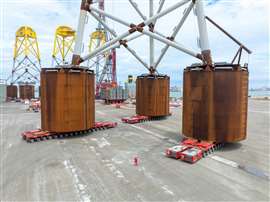 Mammoet SPMT under each of the jackets’ three legs. Photo: Mammoet
Marshalling in Taiwan
Mammoet-Giant was awarded a contract by Ørsted Taiwan to marshal 66 wind turbine jackets for the 920 MW Greater Changhua 2b and 4a wind farms in Taiwan.
It is the first project in the Asia-Pacific region to use suction bucket jacket (SBJ) foundations on an offshore wind farm. Instead of the usual roll-on roll-off method a crane was used to load the jackets onto the vessel.
Self propelled modular transporter was first used to move the jackets to a temporary storage area in the port until they were needed for load out. To do this, with the three legs of the jacket elevated on supports, 32 axle lines of SPMT were driven underneath each foundation and lifted in tandem, using the hydraulics of their suspension with its 600 mm stroke.
On arrival at the storage area the jackets were placed on steel foundations resting on load-bearing mats made from sustainable bamboo. A total of 96 axle lines of SPMT were used across the project.
For the final load-out phase it was a reversal of the above sequence. The jackets were driven back to the quayside and then lifted onto the deck carrier vessel using the SK350 super heavy lift crane (see heavy lifting feature). It ferried them to the offshore installation site in batches of four.
Working together in Hamburg
 All about angles: bringing in one of the shorter steel bridge sections. Photo: Cometto
A trio of German lifting and transport companies worked together to install nine railway bridges in Hamburg, Germany.
Hüffermann Krandienst, Eisele and Thömen Spedition installed the steel structures at Ferdinandstor in the city centre over just a few days. Each one weighed 120 tonnes. They were moved and installed using self propelled modular transporter from Cometto carrying jack up gantry equipment from Enerpac and assisted by seven wheeled mobile cranes.
“Our team’s task is to install nine railway bridges using our Jack-Up and SPMT technology,” explained Rocco Schimmel, head of crane service, heavy installation and project engineering at Eisele. “Since the available space is extremely tight, we first store the bridges in the roundabouts on the outer Alster side and then move them in with pinpoint accuracy when required.”
Space, or lack of it, was an issue for the SPMT. A pair of parallel-coupled six and 4 axle line SPMT modules with a power pack unit (PPU) were each combined with Enerpac JS250 jack-up systems. It allowed the bridges to be installed at an angle of as much as 43 degrees, also taking into account a slope of 8 per cent in the driving direction and 3 per cent sideways.
“What is especially challenging is that we have to place the bridges on the SPMTs at a 45- or 25-degree angle, with only very narrow tolerances within the travel paths inside the bridge channel,” Schimmel explained.
A third module of SPMT was used to bring the bridge sections from storage to the installation location. “The bridges have to be levelled to the centimetre – and that works perfectly. We can lift them to the millimetre – fantastic!” enthused Schimmel.
Instead of five days for the installation, efficient teamwork and reliable equipment allowed it to be cut to three. “The fact that we managed to install the bridges so quickly, precisely and safely is something Cometto, Eisele and Thömen can be truly proud of,” Schimmel concluded.
Fleet expansions
 Mike Brooke, Rigging Gear Sales, joined members of the Berard team for the final delivery inspection.
Rigging Gear Sales completed the delivery inspection on 28 lines of TII-Scheuerle SPMT-ES trailer and two new Z390 power pack units (PPU) to Berard Transportation in the USA. The milestone marked a significant fleet expansion for Berard as the Louisiana-based company celebrated its 80th anniversary.
Mike Brooke at Rigging Gear Sales joined Braedon Berard, beneficial owner and chief operating officer at Berard Transportation, for the final inspection in New Iberia, Louisiana. “This investment not only strengthens our capabilities, but it also reflects our long-term commitment to growth and to serving our clients with the highest standards of excellence for many years to come,” said Braedon Berard.
“When I reflect on how far this company has come, from the time my grandfather first started it, to when I became involved, and where we are today, I will always be grateful. I am especially blessed to share this fleet expansion with my dad by my side, as we continue carrying forward the legacy,” Berard continued.
 From left: Jack Collett, renewables director, Collett & Sons; Mark Howe, UK & Ireland sales manager, Goldhofer; David Collett, managing director, Collett & Sons; Sam Collett, director, Collett & Sons
In the UK transport specialist Collett & Sons added a Goldhofer FTV850 Blade Lifter to its wind turbine transport fleet. It is the company’s second blade lifter which is a cophisticated blade coupling manipulator unit combined with an SPMT type carrier.
The FTV850 consists of four main elements: the lifting module, 8-axle split lines, 6 driven axle lines and a 530 bhp Addrive 2.0 power pack unit (PPU). As per its model designation it is rated at 850 tonne-metres and can carry blades as long as 100 metres.
Wind turbine blades can be elevated up to an angle of 60 degrees and rotated through a full 360 degrees of pitch. In addition to clearing obstacles it allows the operator to feather the blade to a position where it is least affected by wind on the blade.
The split axle lines allow four positions of width adjustment, between 3 and 4 metres. This helps increase stability and weight distribution for blades of different sizes, weights and centre of gravity.
CONNECT WITH THE TEAM