Read this article in 中文 Français Deutsch Italiano Português Español
SPMT to meet giant substation challenges

03 December 2025
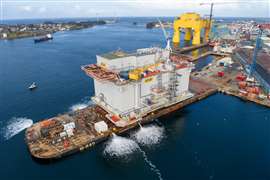 Mammoet ballasting the barge as one of the substations is manoeuvred onboard. Photo: Mammoet
International transport and heavy lifting specialist Mammoet met a series of challenges to transport three giant electrical substations for the world’s largest offshore wind farm.
Dogger Bank Wind Farm is under construction 130 km off the coast of Yorkshire, England in the North Sea. Generating capacity will be 3.6 GW – enough to power about six million homes.
Mammoet was involved in all three phases of the development, weighing and transporting the three giant offshore substations. Literally hundreds of axle lines of self propelled modular transporter had to be sourced and deployed at two locations.
Dogger Bank’s developer is a consortium consisting of SSE (40 %), Equinor (40 %) and Vårgrønn (20%). Working for the consortium offshore engineering specialist Aibel fabricated the steelwork in Thailand before shipping it to Norway. At Aibel’s Haugesund yard more steelwork and the installation of transformers and remaining components was carried out.
Mammoet did the load-outs at Laem Chabang in Thailand, the load-ins at Haugesund and then the final weighing and load-out for onward transport to the wind farm site.
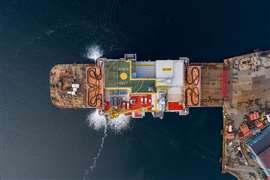 The completed substations each weighed 9,350 tonnes. Photo: Mammoet
The biggest challenge
In Thailand Mammoet used 338 axle lines of SPMT to move the three steel structures. At that time each one weighed around 7,500 tonnes. In Norway 344 axle lines were used, of which 264 did the load-in. The other 80 axle lines were added when weighing the completed substations and making the second load-outs. By that time each module weighed 9,350 tonnes.
The total of 682 axle lines was sourced from Mammoet’s global fleet consisting of more than 4,000 axle lines around the world.
During transport specially fabricated grillage beams sat under the strongest parts of the substation on the SPMT. Aibel fabricated two load-out frames to ensure the substations remained in position when on the move.
From the fabrication yard in Thailand to the port the substations had to be driven 1 km on public roads. It required the removal of fencing and a gravel slope was built for the SPMT instead of using the port’s main entrance.
Inside the terminal the substations were loaded out onto a heavy lift ship via Ro-Ro ramps. The SPMT’s hydraulic suspension was used to lower the modules onto grillages on deck. It was then driven out carrying the interface beams and the load-out frame.
After a 45 to 50 day sail to Norway the substations could be offloaded. Higher allowable ground-bearing pressure at the quayside in Norway meant ‘only’ 264 axle lines of SPMT were needed.
Having added all the remaining equipment in Norway the substations were weighed using 36 weighing jacks and loadcells. For the final load-out 344 axle lines of SPMT were used because of the additional weight of the transformers and other equipment.
To ballast the barge Mammoet used 16 submersible ballast pumps, each with a capacity of 1,000 cubic metres an hour.
Experienced gained from one substation to the next culminated in a saving of one day in Thailand for the final loadout there for Dogger Bank C.
“One of the things Mammoet does so well is to be flexible,” said Dorien Frequin, Mammoet branch manager in Norway. “We help our clients whenever there are small changes to their plans, and our teams work together to adapt to these changes.
Our engineering department works closely with our project managers, who work closely with our planning team to source the equipment needed, and that can all happen in a very short timeframe.”
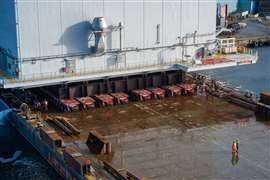 Eight columns of SPMT moving one of the three substations on a barge. Photo: Mammoet
CONNECT WITH THE TEAM