Read this article in 中文 Français Deutsch Italiano Português Español
Strength and flexibility in below the hook equipment

02 September 2026
In addition to stronger components, the under the hook equipment sector is seeing demand for more flexible solutions to cut leads times and assist with a wider range of projects. Daniel Searle reports.
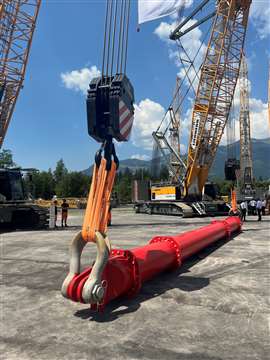 Upending a large lifting beam suspended from two crawler cranes. Liebherr made the demonstration at its open day in Austria in June. Photo: Alex Dahm / KHL Group
The lifting industry has been responding to demand for higher-capacity cranes to handle and manoeuvre bigger components in industries such as wind power and infrastructure. With the cranes lifting heavier loads, under-the-hook equipment, for example, lifting beams and frames, and spreader beams – has had to adapt too. But it’s not all about higher capacities.
“The biggest drivers of sales and innovation in the below-the-hook market are energy transition projects, major infrastructure works, modular construction, and the fact that lifted components are becoming larger, heavier and more geometrically complex,” says Thomas Dietvorst, managing director at UK-based Modulift.
“In project logistics, 2026 is being shaped by demand from renewable energy, power generation, transformers, modules and heavy industrial components. Breakbulk specialists are also pointing to metals, mining, and regional infrastructure investment as active growth areas,” Dietvorst continues.
Offshore and onshore wind remain especially important. “Industry sources expect a strong flow of turbine and transformer shipments in 2026, while offshore wind developers are dealing with the consequences of larger turbines, heavier foundations and a shortage of suitable installation capacity.
Ulstein has pointed to a likely tonnage deficit for installation and transport vessels in 2025 and 2026, driven by an expected 380 GW of offshore wind additions over the next decade, while DNV notes that increasing turbine sizes and monopile dimensions are creating growing installation risk and technical complexity,” explains Dietvorst.
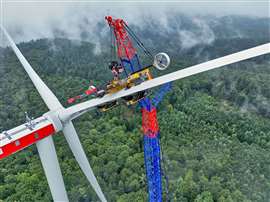 Wind turbine manufacturer Enercon uses Ematec’s RBC-D clamp to lift turbine blades, with the Autonomous Positioning System from Seasight Solutions attached
Flexibility benefits
This complexity and bigger loads are changing what operators are looking for from below the hook equipment.
“For the rest of 2026, the outlook appears positive for specialist lifting equipment suppliers that can offer modularity, short lead times, engineering support and strong compliance credentials,” says Dietvorst. “Customers are not simply looking for higher capacities; they are looking for equipment that is adaptable, reusable, well-documented, and supported by application engineering that reduces risk on site. That suits suppliers that can combine a modular product range with custom design capability and recognised certification.”
Modulift offers a range of standard modular beams and frames through to bespoke engineered equipment, with DNV type approval on MOD series spreader beams in capacities up to 2,000 tonnes.
But Dietvorst also highlights the versatility of the company’s Multi-Point beam.
“It is designed to operate as a lifting beam for low-headroom applications, a semi-spreader beam, or in tandem lift configurations, or with an optional swivel hook depending on the lift arrangement,” he says. “The Multi-Point covers up to 12-metre spans and capacities from 12 tonnes up to 600 tonnes, giving users a highly adaptable modular tool for a broad variety of lifting scenarios.
“The reason for developing and promoting this kind of product is straightforward: operators increasingly need equipment that can do more than one job. On modern projects, there is growing pressure to reduce rigging time, work safely in constrained spaces, and manage multiple lift geometries without bringing in a completely different beam for each stage of the lift. The Multi-Point beam answers that need by giving contractors a modular, reconfigurable product that can be reused over many lifts, rather than a single-purpose solution.”
Caldwell Lifting Solutions launched its Dura-Mod range of modular beams, designed for outdoor projects with larger headroom requirements, such as in heavy construction and infrastructure.
The range enables the spreader pipe sections and end fittings to be configured to create suitable beams for each project. By keeping a stock of multiple capacities, lengths and fittings, Caldwell suggests, distributors and end users can provide the correct beam without waiting for manufacture and delivery. Transport and storage is also made more efficient, the company adds, as the component parts are smaller and lighter than complete beams.
To assist with the configuration process, Caldwell offers its SmartSpec online tool, which calculates the components required for a project based on data inputted by the user, such as overall beam length, sling angle, and capacity.
Tighter tolerances
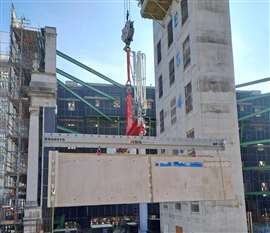 Modular under-the-hook equipment enables flexible solutions to be created, such as this Modulift MP-12 Multi-Point beam used to lift an 8-tonne precast section at a project in London, UK, with 20 mm of spare headroom. Photo: Modulift
Modular equipment can help overcome the challenges associated with schedule pressure and equipment availability, says Dietvorst.
“Customers increasingly need below-the-hook equipment that can be mobilised quickly, reconfigured easily and documented thoroughly for demanding lift plans. The pressure is even greater on megaprojects, where the overall programme depends on placing large, prefabricated sections safely and on time.
“The opportunity, however, is significant. As projects become more complex, the value of engineered below-the-hook equipment increases. There is strong opportunity for suppliers that can offer modular systems for repeat use, custom design for unusual lifts, high levels of QA, and global compliance support. Modulift’s product positioning reflects exactly that, with modular systems that can be reused at different spans, compatibility across product families, and a custom design service supported by proof load testing, third-party witnessing and DNV approval options.”
The capacity for creating bespoke beams with short lead-times is also beneficial on projects with specific challenges and requirements. An example is a lift carried out in Mayfair, London, says Dietvorst.
“One especially relevant example for the Multi-Point beam is the Mayfair lift carried out with RSG Rentals and Keltbray Lifting, where an MP-12 Multi-Point beam was used to lift an 8 tonne precast section under an existing façade retention structure with only 20 mm of headroom to spare.
“The beam’s low-headroom design – 630 mm from the bearing points of the top and bottom shackles – allowed the team to complete the lift safely and efficiently under severe spatial restrictions. It was also delivered in under 48 hours, which speaks to the importance of equipment availability as well as technical suitability.
“Many lifts now take place in dense urban construction sites, inside existing structures, or in partially completed plants and industrial buildings where headroom is extremely limited,” adds Dietvorst. “The Mayfair project is a practical illustration of this trend: the success of that lift depended on finding a beam that could work.”
Specialized solutions
For some projects, even more specialised technology is required. Germany-based Ematec produces the RBC-D 50 and RBC-D 50.1 rotor blade clamps, for lifting and handling wind turbine blades.
As the size of some turbine blades increases, the manufacturer has reduced the unladen weight of the lifting attachment by 700 kg, helping to minimise the overall load.
The clamps are described by Ematec as “the world’s first and only single-blade yokes that automatically and individually adapt to each specific rotor blade, consistently balancing themselves”. The ‘D’ in RBC-D stands for ‘Double’, adds the manufacturer, noting that in addition to the lower gripper, the upper telescopic gripper has 14 hydraulically-actuated and gimbal-mounted grip pads.
The RBC-D 50 is being used by wind turbine manufacturer Enercon, at wind farms such as those in the Black Forest in its domestic market of Germany.
As well as adding new wind power capacity, Enercon is working to upgrade wind farms with newer models of turbine. The adaptive blade mount of the RBC-D 50 allows the same attachment to be used to handle the blades of both the existing turbines and their replacements.
The clamps are compatible with blades from 45 to 110 metres long, with two counterweights on each wing of the system automatically identifying and adjusting to the centre of gravity.
Wind farms are, naturally, typically situated in windy locations. These conditions create energy but also create challenges during lifting operations. To help overcome these challenges, Enercon uses the RBC-D 50 in combination with the Autonomous Positioning System (APS) from Seasight Solutions, which attaches to the clamp. The APS features two pitch propellers and two 15 kW electric motors, operated by long-range remote control, and is designed to eliminate the need for taglines – which is particularly useful in areas such as forests and mountains, where there is limited access for tagline operators to manoeuvre.
The combined technology enables rotor blades to be installed in wind speeds of up to 10 metres a second.
“This allows much greater flexibility in the installation process and significantly fewer weather-related delays,” explains Norman Huske, who trains Enercon installation teams worldwide on using the RBC-D and APS systems.
As a result, all three blades of a turbine can typically be installed in a single day, adds the manufacturer.
On the ropes
To help meet the demands of sectors such as infrastructure, energy, and heavy construction, Ontario-based Unirope has launched its Python DynamiQ non-rotating wire rope.
The rope design combines a 16-strand compacted outer layer with a more robust core, says the company, to deliver enhanced torque balance and structural stability. This minimises internal movement, reduces stress concentrations, and improves performance under load compared with traditional 35 x 7 constructions, adds Unirope.
“In testing, DynamiQ shows up to a 10 % increase in breaking strength and up to a 20 % improvement in bending fatigue life,” says Justin Brown, president at Unirope. “That translates directly into longer rope life, fewer changeouts, and more predictable performance.”
Suitable for crawlers, tower cranes and wheeled mobile cranes, the rope is compatible with both single-fall reeving – where it works effectively with swivels and resists rotation – and multi-fall reeving, where it maintains stability and minimises issues such as block twisting and rope waviness, says the manufacturer.
CONNECT WITH THE TEAM