Read this article in 中文 Français Deutsch Italiano Português Español
The new competitive advantage in cranes and transport

03 September 2026
Why permitting has become one of the industry’s most valuable project management tools. Mike Chalmers reports
When people think about what separates one crane, rigging or specialized transportation company from another across the USA, the conversation often turns to fleet size, engineering expertise or decades of field experience. Increasingly, however, another factor is proving just as important: permitting.
As projects grow larger, schedules tighten and infrastructure investment continues to accelerate across the country, permitting has quietly evolved from an administrative requirement into one of the industry’s most significant competitive differentiators. Companies with an understanding of how to navigate permitting efficiently – while anticipating delays, co-ordinating jurisdictions and planning moves well in advance – are often the companies best positioned to keep projects moving.
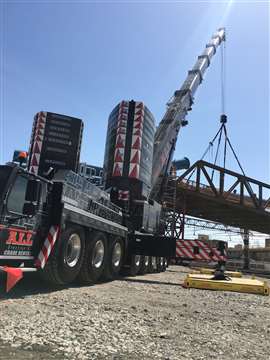 As projects grow more complex, permitting has become a critical part of safe, efficient project delivery. Photo: SC&RA
That shift reflects a broader change taking place across construction and heavy transportation in America. Today’s projects demand far greater co-ordination than they did even a decade ago. Manufacturing expansion, grid modernisation, renewable energy development and the rapid construction of data centres all rely on oversized components moving safely through increasingly complex transportation networks.
Equipment still matters. Experience still matters. But successful project execution increasingly depends on what happens long before the first crane arrives on site or the first load leaves the yard.
“While the elements of an oversize and-or overweight move don’t change when you cross a state line, the rules often do,” said Chris Smith, SC&RA vice president, Transportation.
 Chris Smith, SC&RA vice president, Transportation. Photo: SC&RA
“Compliance can’t be an afterthought – it must be part of the transportation plan itself. Companies that treat permitting as a core planning function are the ones delivering these moves safely and on schedule.”
Essential planning
For many outside the industry, or those coming in from other countries, permitting is often viewed as little more than paperwork. Those responsible for moving oversize and overweight loads understand otherwise.
A single project may involve multiple states, numerous local jurisdictions, utility co-ordination, law enforcement escorts, bridge analyses, route surveys and changing seasonal or weather restrictions. Each element has the potential to influence scheduling, equipment utilisation and overall project costs.
Adding to the challenge, permitting requirements remain far from uniform across the country. Application processes, review timelines, routing requirements and allowable operating conditions can vary significantly from one jurisdiction to the next, making advance planning essential.
As project owners continue to compress schedules, those differences become increasingly consequential. Delays measured in days – or sometimes even hours – can create ripple effects throughout an entire project schedule.
That reality has fundamentally changed how many companies approach project planning. Rather than viewing permitting as a regulatory hurdle to clear before mobilisation, it has become a strategic planning function influencing decisions throughout the life of a project. The earlier potential issues are identified, the more flexibility project teams have to adjust schedules, routing and logistics before delays become costly.
Smith pointed out, “When industry and agencies plan together early, everybody wins.”
Earlier is better
 Successful oversize and overweight moves begin with co-ordination long before equipment reaches the road. Photo: SC&RA
The industry’s response has been to move permitting discussions much earlier into the planning process.
Rather than waiting until equipment has been assigned, many companies now begin evaluating permitting requirements alongside engineering, logistics and constructability reviews. Potential obstacles can often be identified months before mobilisation, allowing project teams to adjust routes, schedules and sequencing before they become costly field issues.
In addition, owners and general contractors are increasingly recognising that permitting cannot be separated from engineering, transportation and lift planning. Decisions made during the earliest stages of a project often influence everything that follows, making collaboration between project stakeholders more important than ever.
That evolution reflects a broader trend throughout the crane, rigging and specialized transportation industries: planning itself has become a value-added service.
More and more, companies are expected to bring permitting expertise, logistics planning and regulatory knowledge to projects – not simply equipment.
 Beth O’Quinn, SC&RA senior vice president, Crane & Rigging. Photo: SC&RA
According to Beth O’Quinn, SC&RA senior vice president, Crane and Rigging, “The mobilisation schedule, crane selection, ground preparation and lift sequencing of a project are all built around when components arrive on site. That’s why the earlier the permitting element can be developed and implemented, the more likely the overall lift plan can be executed safely.”
Critical role
The challenge becomes even greater as projects continue to grow both in size and geographic scope.
Major energy developments, manufacturing facilities, transmission projects and data centres frequently require dozens – or even hundreds – of specialized moves over extended periods. Success depends not only on securing individual permits, but also on co-ordinating those moves across multiple agencies while maintaining consistent communication among owners, contractors and regulators.
In many respects, permitting has become one of the earliest indicators of overall project readiness. When permitting proceeds efficiently, projects are often able to maintain momentum. When it doesn’t, delays can affect nearly every phase of construction.
Such results reinforce the importance of continued collaboration between industry and regulatory agencies. “Our relationships with the public agencies directly involved with this industry are most fruitful when the agencies themselves understand that the critical role they play in our success translates to the success of their state and their communities too,” emphasised Smith.
Path to success
While permitting will likely always remain a complex process, many within the industry see opportunities for continued improvement through greater communication, earlier co-ordination and increased consistency across jurisdictions.
Those efforts are expected to become even more important as infrastructure investment continues and demand grows for specialized lifting and transportation services nationwide.
For SC&RA members working in the USA, permitting is no longer simply a regulatory hurdle to overcome. Increasingly, it has become a strategic discipline – one that influences schedules, supports safer operations and helps determine whether projects stay on track from beginning to end.
“Permitting, transportation planning and lift engineering are all part of the same conversation now,” acknowledged O’Quinn, “and the projects that treat them that way are the ones that finish safely and on time.”
Planning ahead
Five questions every project team should ask early:
- Have all permitting jurisdictions been identified?
- Has permitting been co-ordinated with engineering and logistics?
- Are route, bridge and utility requirements fully understood?
- Has enough time been built into the programme for approvals?
- Does the permitting strategy support the overall lift and transportation plan?
STAY CONNECTED


Receive the information you need when you need it through our world-leading magazines, newsletters and daily briefings.

CONNECT WITH THE TEAM