Read this article in 中文 Français Deutsch Italiano Português Español
The workforce capacity question in cranes and transport

22 October 2026
For years, one number has dominated the workforce conversation: how many people does the industry need?
It remains an important question. Crane, rigging and specialized transport companies around the world continue to compete for qualified operators, drivers, riggers, technicians and other skilled professionals.
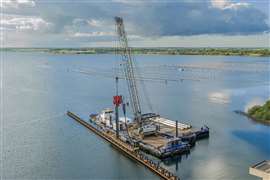
 Active involvement in workforce development. Photo: Boulter Industrial Contractors
But emerging research from USA-based applied research organisation The Simplar Foundation, suggests another question may be worth asking: how effectively are we using the qualified people we already have?
Simplar’s recent Study on Multiskilling in Construction found workers with qualified capabilities across complementary tasks spent considerably more time performing productive work and less time waiting than crews operating within a more rigid single trade.
The numbers are noteworthy. Researchers studied 36 projects across 24 US states, observing 60 multiskilled crews and more than 600 workers. Multiskilled crews spent roughly half their time performing direct construction work compared with approximately one-third when workers were restricted to their primary trades. Waiting and idle time fell substantially.
In a separate controlled trial, reducing handoffs between trades shortened completion time for a closely sequenced scope of work by approximately 30 per cent.
None of this suggests specialists are becoming less important. Quite the opposite, actually.
The principle behind multiskilling isn’t putting unqualified people into specialized roles or asking employees to perform work they haven’t been trained, certified or authorised to perform. It’s about maintaining that core expertise while developing additional, complementary capabilities allowing qualified people to contribute when project requirements change.
Such a distinction is particularly important in our industry. But between rigid specialization and unrestricted task sharing is a considerable amount of room to think differently about workforce capability.
Operational value
 Joel Dandrea, SC&RA chief executive officer
Consider how many moving pieces come together during a complex lift or specialized transport operation. Planning, equipment preparation, inspections, mobilisation, rigging, transportation, site co-ordination and execution can involve numerous people whose responsibilities intersect throughout a project.
Every handoff creates the possibility of waiting, which is sometimes unavoidable. Simplar’s findings, however, offer an interesting way to think about that problem. Its field analysis estimated that restricting the observed multiskilled workers to single trades would have required approximately 45 to 72 per cent more worker-equivalent capacity to accomplish the same sequence of work.
That doesn’t mean similar numbers automatically apply to our industry. But the underlying idea deserves consideration.
Workforce capacity isn’t necessarily determined only by headcount. It can also be influenced by how skills are distributed across an organisation and how effectively people can be deployed as work changes. There is also value for employees in that approach.
A professional who develops complementary skills becomes capable of contributing in more situations. That can create opportunities to remain involved throughout more phases of a project, take on broader responsibilities and ultimately move into supervisory, planning or leadership positions.
For employers, it can build greater resilience into an operation. Instead of every change in workload creating an immediate need for another person with one particular skill, broader capabilities within the existing team can provide additional options.
This isn’t a solution to the industry’s workforce shortage. We still need more people and we still need specialists whose experience and expertise cannot simply be replicated through additional training. But workforce strategy doesn’t have to begin and end with recruiting.
As companies consider the people they’ll need in the years ahead, there may be equal value in examining the capabilities already inside their organisations. Where can complementary training create greater flexibility? Where do unnecessary handoffs create delays? Which employees are ready to expand their skills? And where could broader knowledge create both operational value and a stronger career path?
Ultimately, the workforce challenge is about more than how many people we have. It’s also about what we’re enabling them to do.
STAY CONNECTED


Receive the information you need when you need it through our world-leading magazines, newsletters and daily briefings.

CONNECT WITH THE TEAM