Read this article in 中文 Français Deutsch Italiano Português Español
Putting on weight: telescopic crawler focus

14 October 2026
Telescopic crawler crane demand keeps climbing toward bigger capacities, and manufacturers are putting on weight – and entering new markets – to meet the moment.
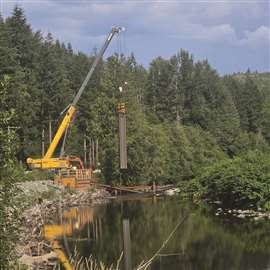 Washington-based construction firm Ceccanti uses its Grove GHC220 at a riverbank site. Photo: Manitowoc
Twenty years ago, a telescopic crawler was a curiosity; a hybrid machine built for the rare job that needed a rough terrain crane’s reach without the ground conditions to support one. It was treated as a specialty tool, and worth owning if a fleet happened to land the right kind of work.
That perspective is all but extinct today. Telescopic crawlers have become one of the fastest-growing categories in the crane industry, and the growth shows up most clearly at the top of the capacity chart where 150-, 180- and 220-ton machines are increasingly doing work that once belonged to lattice-boom crawlers three times their size.
That shift shows up everywhere this year: in a new model built to fill one specific gap in a capacity lineup, in a product line resurrected after 14 years away and in a manufacturer making its first serious push into the North American market.
No matter the region or company, it seems the market for larger telecrawlers is only growing bigger.
Building to fill the gap
When Link-Belt engineers were looking for their next telescopic crawler, they didn’t have to guess what the market wanted. Instead, customers told them directly: something that fit between the existing 140-ton TCC-1400 and 250-ton TCC-2500, with retractable side frames and a transport weight light enough to move easily.
The result is the new 180-ton TCC-1800, a crane built, quite literally, to fill a gap on a capacity chart.
“Over the past year, customers have asked for a larger telescopic crawler... with competitive capacities, retractable side frames and a low transport weight,” said Michael Dawson, Link-Belt’s product manager for lattice and telescopic crawler cranes. “The TCC-1800 exemplifies this philosophy.”
Link-Belt isn’t alone in seeing that pull toward bigger capacity, and the rest of the field backs it up with numbers, not just impressions.
“The market for machines greater than 94 tons is about double that of machines below 94 tons so far this year,” said Allen Kadow, Tadano’s product manager for telescopic and lattice boom crawler cranes. “It’s not a ‘push’ as much as need.”
Liebherr’s data points to a similar shift, landing in a slightly different bracket.
“The demand is strong for all classes currently. However, the larger capacities – 150 and 220 – see the highest demand,” said Brian Peretin, general manager of mobile and crawler cranes at Liebherr USA.
Manitowoc reports the same pattern from its own order books: the company’s two most in-demand telescopic crawlers right now are the 140-ton Grove GHC140 and the 220-ton GHC220, its largest model.
“Customers continue to seek higher-capacity machines that provide greater lifting capability while maintaining the mobility and ease of use that telescopic crawlers are known for,” said JJ Grace, Manitowoc’s product manager for Grove’s GHC cranes.
Andreas Ernst, president of Raimondi North America, put the shift in the plainest terms of anyone. “The capacity range today is trending towards larger; above 100 tons,” he said.
Four manufacturers, four different capacity brackets, one consistent answer. That kind of agreement is what makes this look less like a passing cycle and more like where the category is headed.
Two ways to chase demand
But scaling up indefinitely isn’t realistic, and manufacturers know it. Going meaningfully larger than the highest capacities currently offered, Peretin said, runs into real logistical friction.
“Due to the challenges of moving and assembling larger crawler cranes, going much larger than the current offering creates additional costs and challenges. However, there certainly have been inquiries for telecrawlers with greater capacities than currently offered,” Peretin said.
That constraint is part of why not every manufacturer is chasing this demand the same way. Link-Belt extended an existing lineup with one new crane built to close a specific gap. Others are treating the shift itself as a reason to build a telescopic crawler presence from nothing.
Enter Terex Rough Terrain, which returned to the category for the first time in 14 years. The division launched its new TTC 70 this year, engineered and built at the company’s Crespellano, Italy headquarters.
“The unveiling of the TTC 70 marks a pivotal moment for Raimondi as we continue to evolve into a fully integrated, multi-segment lifting solutions provider, meeting the evolving needs of the global lifting industry,” said Luigi Maggioni, CEO of Raimondi Group.
The company framed the move as a direct response to market conditions, not nostalgia for a legacy product line.
“The decision to re-enter the crawler crane segment reflects shifting industry requirements, particularly in applications where versatility, mobility, and performance in challenging environments are critical,” said Stefania D’Apoli, global sales director for Terex Rough Terrain.
Special specs
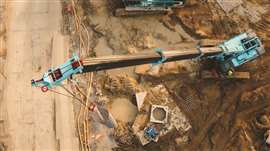 XCMG XTC160 telescopic crawler crane Photo: XCMG
China-based XCMG is making a similar wager from a different starting point; not a return to the category, but a first serious push into the North American market with its new XTC160, a 176-ton telescopic crawler.
Cui Dandan, deputy director of R&D for telescopic crawler cranes at XCMG’s Hoisting Machinery Research Institute, described the 110-to-185-US-ton class as one of the most widely used segments in North America, supporting wind power auxiliary lifting, power grid projects, bridge maintenance and general industrial construction.
“Beyond lifting capability, contractors and rental companies are increasingly considering fuel efficiency, intelligent features, maintenance convenience, residual value and compliance with regional safety standards,” Cui said.
Cui put a number on that dominance: the 110-to-185-ton class alone accounts for roughly 30% of the entire North American market, with the 55-to-100-ton range adding another 25%.
But it’s not a repeat of the last boom. “The current project benefits can support the next two to three years, but it will not continue the explosive growth seen in 2022-2023,” Cui said. “The market is expected to be back to stable growth.”
Not every manufacturer chasing this shift is competing on capacity alone, either. Liebherr’s answer to what sets its telescopic crawlers apart wasn’t about size at all.
“Liebherr offers VarioBase, a variable supporting base that not only provides greater safety for telescopic mobile cranes, but also allows significantly higher load capacities, especially for lifts directly over the supports,” Peretin said.
The LTR 1150 is the first Liebherr telescopic crawler equipped with the system, which calculates optimum load capacity in real time based on track width and rotation angle. The same crane also carries a first for Liebherr’s telecrawler line: newly calculated WindSpeed Load Charts, letting it work safely at wind speeds up to nearly 35 mph; a meaningfully higher threshold than the company’s previous telescopic crawlers allowed.
Pushing up capacity
The “why” behind the shift comes down to what’s getting built. Wind, bridge and foundation work remain the traditional core of telescopic crawler demand, but a newer driver keeps showing up: data centers.
“Despite the applications for telecrawlers remaining consistent in recent years, the demand for their use in data center construction has greatly increased,” Peretin said. “Between the construction of the data centers themselves and the electric infrastructure required to power them, telecrawlers are a versatile option to be used throughout the entire development process.”
Grace described the same pull from Manitowoc’s side of the market, pointing to data center construction and broader infrastructure investment as key drivers behind demand for the company’s largest machines.
“We’re also seeing significant activity in data center construction and infrastructure projects,” Grace said. “These markets continue to expand, creating opportunities for telescopic crawlers due to their versatility, mobility and ability to work efficiently in challenging site conditions.”
XCMG’s Cui named data centers, LNG projects and energy storage facilities as a distinct emerging category, separate from the traditional infrastructure and energy work telescopic crawlers have long handled; projects that “increasingly require equipment that can handle frequent relocation, precise lifting and operation in restricted areas.”
Two builds already underway show what that combination looks like in practice.
Manitowoc recently delivered the first GHC220 in North America to Ceccanti, a construction company using the 220-ton crane on infrastructure work in Washington state, including construction of a 1.25-million-gallon underground storage tank in Seattle.
Sany, meanwhile, sold one of its first SCA1600TB telescopic crawlers in North America to CJ Mahan Construction, of Ohio, deployed on a US Army Corps of Engineers barge project on the Tennessee River.
Different manufacturers, different jobs, same underlying story: telescopic crawlers doing work that used to require something bigger, and far less mobile.
At the very top of the market, Cui pointed to an even more specific driver: prefabricated bridge installation, which she said increasingly demands cranes rated at 260 tons or more; a bracket few manufacturers are building toward yet, and one that may define the next stage of the capacity climb this piece keeps tracking.
Size still matters
None of this means the smaller end of the market has disappeared. For all the attention on the top of the capacity chart, the segment that started this whole category – compact, tight-access machines – is still doing real work.
Manitowoc’s small crawler range includes the 55-USt GHC55, which transports in a single load, and the 85-USt GHC85, featuring what Grace called “best-in-class pick-and-carry load charts up to four degrees.”
Both, he said, see strong demand in the energy sector, along with foundation work, bridge construction and highway projects; jobs where access, mobility and setup speed matter more than raw lifting capacity.
Link-Belt covers similar ground with two models of its own.
“The 55-ton TCC-550 is an excellent utility and assist crane, transporting in one load with standard counterweight,” Dawson said, while the 80-ton TCC-800 is “widely used on utility work, commercial construction, site development, maintenance, and small foundation applications.”
Tadano’s small-capacity range runs deepest of the three.
“Tadano offers 35-, 60-, 70- and 90-ton capacity cranes in this class,” Kadow said, popular for “foundation, bridge and heavy civil, powerline construction and maintenance, commercial construction and barge work.”
What’s next?
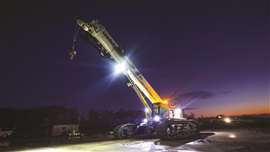 A Link-Belt TCC-1800 lit up for overnight work. Photo: Link-Belt
If capacity is this year’s clearest trend, XCMG’s Cui pointed to what may be next: electrification.
“As regulations on emissions and construction-site noise continue to tighten, customers are looking for solutions that reduce energy consumption while maintaining productivity,” Cui said.
The company started developing battery-powered telescopic crawlers aimed at zero emissions and reduced jobsite noise, designed for urban construction, indoor projects and environmentally sensitive sites where a diesel machine isn’t a realistic option. The electric models, Cui said, are being built to match the lifting performance and pick-and-carry capability of their diesel counterparts, with flexible charging options built in.
XCMG was the lone manufacturer to raise electrification directly this year, which makes it worth watching rather than declaring a trend. But it’s a natural next question for a category that has spent this entire cycle focused almost exclusively on how much a machine can lift, rather than how it’s powered.
For now, the clearest signal remains the one nearly every manufacturer described independently, without prompting from each other: telescopic crawlers keep getting asked to do more, at greater capacity, on tighter sites.
And the companies building them are responding by either engineering directly into that demand, or wagering that the category itself is worth entering all over again.
This article originally ran in the September edition of American Cranes & Transport magazine. Read the full edition here.
Conversions
| US | Metric |
| 1 ton | 0.907 tonnes |
| 1 foot | 0.305 metres |
| 1 pound (lb) | 0.454 kilograms |
| 1 mph | 1.609 km/h |
| 1 gallon | 3.785 litres |
Product Roundup
Grove GHC220
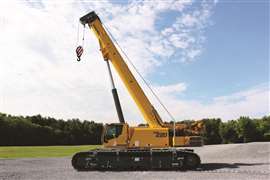 Capacity: 220 tons | Main boom length: 185 ft | Maximum boom length: 265.7 ft | Counterweight: 124,782 lb (upper counterweight)
Link-Belt TCC-1800
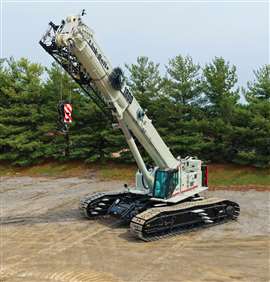 Capacity: 180 tons | Main boom length: 42.7–197.3 ft | Maximum boom length: 314.3 ft (with all extensions and SmartFly) | Counterweight: 77,000 lb upper / 9,000 lb lower
Liebherr LTR 1150
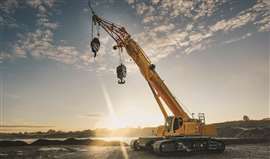 Capacity: 170 tons | Main boom length: 37–171 ft | Maximum boom length: 171 ft | Counterweight: 90,400 lb
Terex TTC 70
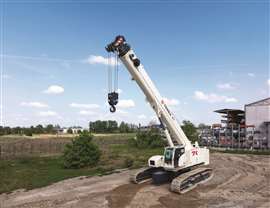 Capacity: 77 tons | Main boom length: 120.7 ft | Fixed jib length: 26.2–49.2 ft | Max tip height (with jib): 177.2 ft | Max transport width: 9.8 ft | Counterweight: 39,683 lb (heavy) or 11,023 lb (light configuration)
XCMG XTC160
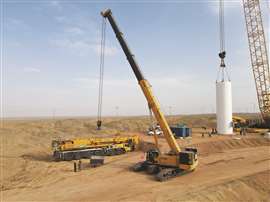 Capacity: 176 tons | Main boom length: 45.6–213.3 ft (six-section) | Maximum boom length: 300.2 ft | Counterweight: 97,000 lb (44 t)
Tadano GTC-600-2
Sany SCA1600TB
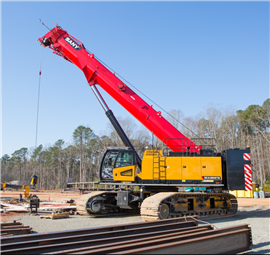 Capacity: 160 tons (at 9 ft) | Main boom length: 196.5 ft (six-section, pin-and-latch) | Fixed jib length: 30.8 ft / 50.9 ft (two-piece bi-fold, offsets at 0°, 15°, 30°) | Max tip height (with jib): 247 ft
STAY CONNECTED


Receive the information you need when you need it through our world-leading magazines, newsletters and daily briefings.
CONNECT WITH THE TEAM