Read this article in 中文 Français Deutsch Italiano Português Español
Mammoet SPMT stars in bridge installation

01 October 2026
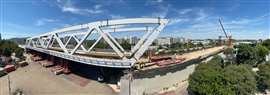 Build the bridge section in an elevated position next to its installation point, put SPMT underneath it and drive it towards the abutment enough to get some SPMT with towers under the end at the lower level (SPMT moved down from the upper level by crane with the tower added). Turn the wheels on the lower SPMT to steer by 90 degrees. Drive the bridge off a little further, add more SPMT from the top with a tower, drive it off a little more, repeat until all the weight is transferred to the lower SPMT with towers. Then drive the bridge the rest of the way across to the other abutment, lower it using the SPMT suspension, drive SPMT out, clear up, reopen road. Photo: Mammoet
Self propelled modular transporter (SPMT) was a vital tool for a job to get a new railway bridge in place over one weekend in Hungary.
Using SPMT instead of a skidding system to install the first Közvágóhíd railway bridge minimised the amount of civils work required and streamlined the bridge launch. In addition, the bridge sections were fabricated as close as possible to the installation site to help simplify the job and reduce the amount of disruptive movement needed for large components.
Working for V-HID, a Hungarian construction company specializing in railway and bridge infrastructure, Mammoet installed the first of two spans of the new Közvágóhíd railway bridge in Budapest.
Being in a busy area of the city and over a main road made this job more of a challenge. It is near Budapest Park over a street called Soroksári út.
Using SPMT and putting the bridge “up from under” instead of lowering it “down from above” shortened the project schedule to days instead of weeks.
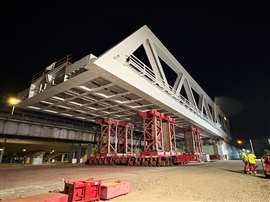 Mammoet followed the Accelerated Bridge Construction (ABC) method on this job in Hungary. Photo: Mammoet
Previous bridge launches by V-HID used skidding systems but this would have required closing the road to build support towers on the road below and skidding the bridge over them.
Instead, Mammoet built the support masts on top of the SPMT and drove them underneath the bridge. It was quicker and didn’t leave holes in the road.
Making it happen
Space was an issue when it came to assembling the bridge sections because three separate areas were needed. With that done four sets of SPMT were needed, two on the ground level and two at the upper level. These launched and then supported the bridge.
The bridge was driven forward until it was cantilevered whereupon the first set of SPMT, with its support masts, was driven underneath, Mammoet explained.
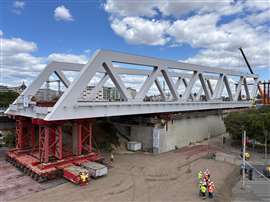 Hungary for a new bridge: a total of 176 axle lines of SPMT were chosen instead of a skidding system for this bridge job. Photo: Mammoet
Each support tower for the lower level SPMT was made from a mast section of one of Mammoet’s MSG cranes with a fabricated frame on top.
The first, upper, SPMT movement launched the bridge section off the abutment. Next, from ground level, it took the section across the gap. As the bridge move progressed, more SPMT modules were lowered in single lines from the upper to the ground level using a 400 tonne mobile crane.
Following reconfiguration support masts from the assembly area were added before driving them underneath the bridge. When there were three sets of SPMT (4 x 12 axle lines) under the bridge it could then reach both abutments. A total of 176 axle lines were deployed.
Doing it this way meant the main road under the bridge only had to be closed over a weekend, instead of for weeks on end.
Installing the north bridge side will be done in the same way. It will be more difficult because there’ll be even less space with the south side bridge already in place.
“Our expertise and flexibility in terms of engineering solutions and equipment, allows us to adapt to technical challenges,” said Jordy van der Hoeven, Mammoet project manager. “We always find a way because if we don’t have something in our fleet to fix or solve a problem, we build it.”
STAY CONNECTED


Receive the information you need when you need it through our world-leading magazines, newsletters and daily briefings.
CONNECT WITH THE TEAM