
29 July 2026
Mammoet’s XXL monopile handling system and its MTC 1600 terminal cranes helped make marshalling increasingly large offshore wind foundations safer and more efficient.
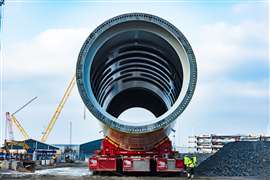 Three rows of 26 axle lines of SPMT carried the XXL monopile transport system. XXL monopiles are just that: these were up to 1,680 tonnes, the longest were 86.3 metres and 9.1 metres in diameter. Photo: Mammoet
As offshore wind moves into deeper water and suitable sites become harder to find, the turbine foundations are getting bigger and more awkward to handle.
Their diameter, height and weight are all increasing. Capacity and capability of the equipment needed to lift, transport and install them also has to increase.
International heavy lift and transport specialist Mammoet has developed its own solutions. Its XXL monopile transport system, introduced in 2024, is designed to handle the world’s largest and heaviest monopiles.
For the lifting work the 1,600 tonne capacity MTC 1600 terminal cranes have made their first appearance on site. Lifting in tandem, a pair of these cranes can lift XXL monopiles working in a way akin to a production line.
Both these specialized transport and lifting methods were used in a project for offshore engineering contractor Van Oord. Mammoet marshalled more than 70 monopiles for the Baltic Power offshore wind farm. Developers Orlen and Northland Power are scheduled to have it operational later this year. It will have capacity to deliver 4 TW-h of electricity a year.
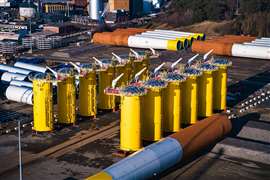 Monopile foundations (horizontal) and their transition pieces (78 of each) were all marshalled by Mammoet. Photo: Mammoet
Big and batched
Each monopile weighed as much as 1,680 tonnes. The longest were 86.3 metres long and 9.1 metres in diameter.
The 78 monopiles were shipped by barge in batches of three to the Port of Ronne in Denmark where Mammoet unloaded them on 78 axle lines of self propelled modular transporter (SPMT) mounted with the XXL monopile transport system. Its hydraulically folding saddles cradled each monopile.
Using the system’s jacking spacers combined with the suspension stroke of the SPMT the monopiles were lifted from their sea-transit grillages. From there the SPMT carried them to temporary storage on gravel bunds.
Fully extending the jacking spacers gave 600 mm of lift, allowing the monopiles to be placed into and retrieved from the bunds, despite the greater lift distance required by the larger monopiles.
Having foldable saddles allowed lower and shorter bunds which meant less gravel.
Moving on
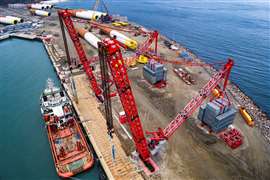 A pair of Mammoet terminal cranes, MTC 1600, lifted the horizontal monopiles in tandem. Photo: Mammoet
Before the load-out, each monopile was lifted from storage and taken to a plugging station for end plugging and airtightness testing so they would float. From there they were driven to the quayside, where the two MTC 1600s lifted them into the water for towing out to Van Oord’s giant heavy lift installation vessel Svanen.
Jaap van der Riet, Mammoet commercial manager, explained, “When we were in discussions with Van Oord, it wanted to upgrade the Svanen to have a 3,000 tonne lifting capacity, so the vessel could install XXL monopiles in the Baltics.
“To further support that, we said we would develop cranes and systems that matched this capacity. This is a real strength of Mammoet: if no solutions exist, we develop them, together with our clients, to meet their specific needs”.
The smaller transition pieces that fit between the monopile foundation and the base of the turbine tower were lifted onto the SPMT using an 800 tonne capacity Liebherr LR 1800 lattice boom crawler crane.
It was a 23 km journey out to sea to the Polish settlements of Choczewo and Łeba.
“If no solutions exist, we develop them, together with our clients, to meet their specific needs,” van der Riet commented.
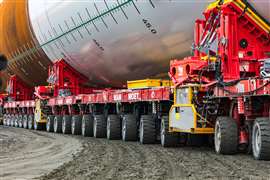 Mammoet’s XXL monopile transport system was mounted on 78 axle lines of SPMT. Photo: Mammoet
CONNECT WITH THE TEAM