
09 November 2025
Boom trucks cater to many specialized lifting markets. D.Ann Shiffler reports.
For the most part, five manufacturers participate in the North American boom truck market – Altec, Elliott, Load King, National and Manitex, which was acquired by Tadano at the start of 2025.
 Boom trucks are easy to operate and can be dispatched quickly.
Each of the boom truck OEMs have a distinct niche in the markets they serve. Some companies specialize in large fleets of boom trucks, using them as taxi cranes that can perform two or three jobs a day. Booms trucks are easy to operate and can be dispatched quickly. Boom trucks are also popular owner/operator machines, especially in the tree and sign industries.
ACT asked each boom truck producer about their boom truck product line up and the markets they serve.
Load King
Load King is dominant in the utility market (high reach with basket), general construction and oil, according to John Lukow, senior vice president of cranes for Load King.
“We think the North American boom truck market is about 1,000 units and will probably be stuck there,” he said. “I don’t see any economic factor that is likely to move that needle. Fortunately, we still have room to grow in this space. We expect to see double-digit growth for the next couple of years.”
Load King’s range of boom trucks is from 10 to 80 tons capacity. Lukow said Load King segregates its boom trucks into three categories.
First is the 10 to 30-US ton category.
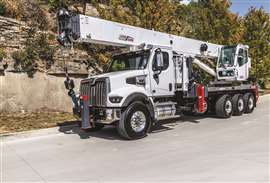 Load King 40-142RS Capacity: 40 US tons Maximum Boom Length: 142 feet Jib Length: 55 feet Maximum Hook Height: 207-foot tip height Hook height: 204 feet Outrigger type: Out and down
“The key phrase is simple, reliable and cost effective,” he said of these models. “These just go to work, do what they are supposed to do and deliver years of service.”
Next, he said is the 30 to 45-ton market.
“Here we add some sophistication, mainly longer booms,” he said “This is where the small crane company steps up into their first riding seat or 127-foot boom. All out and down (outriggers) in lieu of A-frames with a comfortable cab on the RS.”
And then he described the last market, which is 50 tons capacity and higher.
“This is the Crossover,” he said. “It’s a real truck crane on a commercial chassis.”
The Load King models are rated at 10 feet (3 meters), instead of the competitor’s 5 or 6 feet (1.5 to 2 meters). Lukow said these models have lots of modern features including the LK-1 control system, formed booms and touch screens with intuitive technology.
“I think we also differentiate by listening to our customers and making improvements,” he said. “Examples include adding a tilt cab to the joystick, asymmetrical outrigger support and A92.2 basket work.”
Load King has also improved the remote systems on all its smaller cranes, Lukow said.
“A new larger cab is being introduced on the RS with tilt, and LK-1 control system,” he said. “Extended outrigger jacks are being introduced on all the Crossovers +9-inch penetration.
A new interior is being introduced on the Crossover cab next year, eliminating all the remains of the RT cab. They have removed all the old switches, matching panels and operator storage.
“We have a new ladder planned for the Crossover,” he said. “My point is we are going to keep fine-tuning the product to suit customer feedback.”
Manitowoc National
Bob Ritter, Product Manager of National Crane, said that there is a cautious approach to new equipment purchases with the evolving tariff discussions for many of the markets.
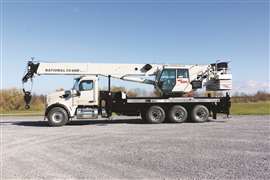 National NBT60XL Capacity: 60 US tons Maximum Boom Length: 151 feet Jib Length: Two options – 36-foot lattice and 26 to 45-foot tele-jib Maximum Hook Height: 205 feet Outrigger type: Four-position out and down
“We still see a strong demand for cranes in the utility markets such as telecom and electrical transmission/distribution work,” he said. “Over the past several years, there has been a consistent trend to larger boom truck capacities – 40 tons and higher have seen the most growth while 30 tons and below remain strong, yet steady.”
What will it take to see an uptick in the boom truck market?
“We think once the activity around tariffs starts to normalize the activity and demand in boom truck end markets will trend upwards,” Ritter said. “National Crane has been a market leader by working very closely with our dealer distribution network and end customers to develop the right products for their applications. We focus on how our products can work for our customers. We do this through many factory-built customizations to go along with our already best in class load charts and ease of operation.”
National Crane’s product range extends from 10 to 60 tons.
Elliott
Elliott President Jim Glazer said the boom truck market is fairly steady.
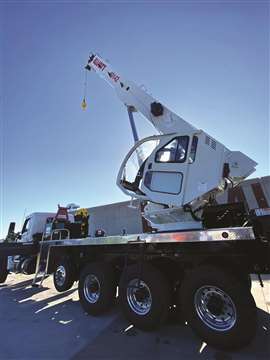 Elliott 40142 Capacity: 40 US tons Maximum Boom Length: 142 feet Jib Length: 57 feet Maximum Hook Height: 209 feet Outrigger type: Out and down
“We find the market to be steady overall,” he said, “with pockets of strong demand where long reach and customization matter, such as utility transmission work, public-sector maintenance (traffic/lighting/water), and engineered jobs that need longer booms, augers, rail gear, platforms or specialty tooling. Rental first, then purchase, continues to be a common path in transmission.”
The strongest markets for Elliott are utility and transmission contractors, government/municipal and custom/engineered applications, where Elliott’s long-boom, factory-custom approach wins, Glazer said.
“The capacities in the most demand are the 40 to 50-ton capacities for transmission/heavier construction picks and 18 to 36 tons for public works, sign/lighting and general construction where non-CDL or compact footprints matter.”
As for what it will take to drive the market, Glazer pointed to grid hardening and transmission build-out, municipal infrastructure cycles, greater availability of chassis and faster lead times.
“Elliott’s ability to engineer multi-function trucks helps owners justify CapEx when volumes are uncertain,” he said. “Elliott’s boom trucks are distinguished by long-boom reach with smooth, chatter-free operation, friction-free jib extension; field-proven reliable designs with outstanding fit and finish; operator visibility, ergonomics and control smoothness; an industry-leading warranty; and customization from the factory (augers, platforms, rail gear, tool circuits, storage; multiple control packages) so fleets get one machine that does more work.”
Elliott’s boom trucks fall into three families, from 10 to 50-ton capacities, Glazer said.
The 10 to 18-ton models have boom lengths from 39 to 125 feet; the 26 to 36-ton models have boom lengths from 51 to 142 feet and the 40 to 50-ton models have boom lengths from 95 to 142 feet.
Altec
Altec Cranes Market Manager Ryan McGiboney said Altec primarily serves the electric utilities market with its boom truck cranes – specifically transmission construction and maintenance.
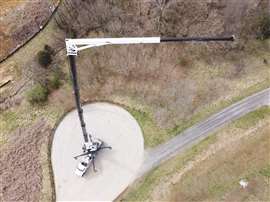 Altec AC65E-155S Capacity: 65 US tons Maximum Boom Length: 155-foot main boom Jib Length: 32 feet (retracted), 50 feet (extended) Maximum Hook Height: 215 feet max sheave height (with jib), 211 feet max hook height (with jib) Outrigger type: Swing out-and-down with four distinct outrigger spans and Smart Zone Rating functionality, allowing the user to deploy each outrigger in any position in space.
“In those segments, I would characterize the boom truck market as extremely positive with significant growth and demand,” he said. “The strongest markets within electric utilities is transmission construction and maintenance. The 45 to 65-ton segment is in the most demand.”
McGiboney said the market isn’t totally flat.
“The entire boom truck market dropped 35 percent at the onset of the Covid pandemic,” he said. “Since then, we have seen steady 7 to 10 percent year-over-year growth since 2021.”
He said there are also some interesting nuances to the recovery of the boom truck market.
“The small, stand-up crane volume is dropping compared to larger swing-seat cranes,” he explained. “These larger swing-seat cranes make up more of the market than they used to. Smaller, typically stand-up cranes had historically held most of the boom truck volume. However, in 2022, the overall volume of large cranes surpassed small cranes, and has remained like that ever since.”
Speaking specifically about the transmission market segment, where maximum boom tip and platform working height are king, he said, “Altec is seeing fantastic growth in demand for long boom machines.”
“I think the reason boom trucks sell well into the transmission/electric utilities market is because the market is used to the formula of a machine mounted on a vocational chassis,” he said. “It’s what utilities and utility contractors have always had with their other equipment, such as digger derricks and aerials. To that end, I think what it will take to see a major uptick in the boom truck market is a step change in the legislation, incentives and regulatory processes around new transmission planning. We are in an historic growth period for the electrical grid, but the pace is throttled almost entirely on state and federal permitting and other aspects of the transmission planning process.”
Regarding other market segments, McGiboney said the newest generation of the large swing seat boom trucks are pushing the limits of capacity, reach and technological sophistication.
“The arms race of developing a bigger and better boom truck has pushed us
into the lower end of what truck cranes and all-terrain cranes can do,” he said.
“In those markets, owners and operators are used to the form factor of what an
all-terrain truck is. So, in these segments, it will take time for users to feel comfortable with the unit-on-chassis, cable-crowded boom style architecture of a boom truck crane.”
The attributes of Altec boom trucks are that they are dual rated to ASME B30.5 and ANSI A92.2, he said. Altec produces boom trucks from 40 to 65 tons.
Tadano Manitex
Retail demand for boom trucks is flat year- over-year, according to Randy Robertson, Director of Inside Sales for Manitex, now owned by Tadano.
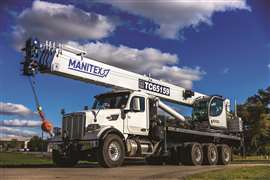 Tadano Manitex TC65159 Capacity: 65 US tons Maximum Boom Length: 159 feet Jib Length: 38 feet Maximum Tip Height: 209 feet Outrigger type: Out-and-down
“This is mainly due to inflation and interest rates” Robertson said. “Lower interest rates would stimulate customers on the fence to buy before the end of the year.”
Robertson said the strongest markets for boom trucks is in the utility sector.
“Demand for boom trucks in the above ground utilities is strong,” he said. “Cross country transmission line construction projects are ramping up, driving demand for high reach machines equipped for utilities.”
In terms of capacities, the 30-ton capacity and higher machines are “the mainstay” of the industry, Robertson said.
“Swing cab models are becoming more popular in operated, maintained fleets, due to their mobility and quick setup to tackle daily taxi-crane applications,” he said. “Conventional boom trucks still have a place in the utility and mining sectors as well as commercial and residential material delivery applications.”
Robertson said there may be an uptick in the market towards the end of the year.
“The annual IRS Section 179 program incentivizes buyers to purchase new equipment and typically boosts sales at the end of the year,” Robertson said. “This should help to reduce inventory and make room for new equipment going into 2026.”
While the transition from the Manitex product to the Tadano product line is currently underway, Robertson said Manitex boom trucks are distinguished in the market for a number of reasons.
“New features and options include asymmetrical outrigger spreads and the self-leveling feature on select models of the TC-Series,” he said. “Tadano Manitex offers short, compact crane packages ranging from 22 to 50-ton models that can navigate tight streets and residential areas for tree care and construction applications. The shorter configurations are widely popular with smaller operated-maintained fleets.”
He said Remote Winch Control (RWC) and Remote Outrigger Control (ROC) are new options for the popular 22101S, widely used in tree care. These features make machines easier to set up and move for one-man operation, he said.
“Manitex introduced the ECSY, Electric Crane System, at ConExpo 2023 in response to oil and gas service companies’ request for electric-powered cranes,” he said. “There is growing interest in operating on well locations without having to run a diesel engine to power the crane. The ECSY package can be ordered with a new unit or added to an existing rental machine, making rental fleets more diversified.”
The Tadano Manitex ranges in capacities from 19 to 65 tons with a maximum tip height of 209 feet.
STAY CONNECTED

Receive the information you need when you need it through our world-leading magazines, newsletters and daily briefings.
CONNECT WITH THE TEAM